- This topic is empty.
-
AuthorPosts
-
2026-10-19 at 5:21 pm #10855
Why Powder Metallurgy Compaction Demands a Different Class of Press
Powder metallurgy compaction is a forming step where small deviations in force and position propagate through the entire downstream process. A compact pressed at inconsistent pressure yields uneven density, which then complicates sintering, dimensional control, and final part quality. The equipment layer, in other words, sets the ceiling for everything that follows.
The presses traditionally used for this work carry three persistent problems. Pressure control is inconsistent from cycle to cycle. Laboratories contend with noise pollution during operation. And data traceability is difficult, because the pressing event itself is rarely captured in a form that can be reviewed later.
Hydraulic systems add their own complications. Excessive heat and energy waste are common, and oil temperature instability directly affects precision — a thermal problem that masquerades as a process problem.
Guangdong Taihe Machinery Equipment Co., Ltd., operating under the brand Taihe, builds high-precision servo presses and mechanical equipment for laboratory research and industrial production. With documented cases in Beijing and Hangzhou, the company’s work sits precisely at the intersection of these pain points: delivering intelligent, high-precision, and flexible pressing and bonding solutions for advanced material research and precision manufacturing.
Inside the Engineering: How Closed-Loop Servo Control Changes Compaction
Necessity. For powder metallurgy and adjacent material research, repeatability is the product. A press that cannot hold thrust and position cannot produce a comparable batch, and a compact that cannot be compared cannot be optimized.
Principle logic. Taihe’s differentiated approach rests on full closed-loop control for precise pressure, speed, and position management. In the electric cylinder type, torque and speed are adjusted in real time, which translates into exact thrust and position management at the tooling interface. Multi-stage control allows operators to set multi-stage pressure, stroke, and speed, adapting a single machine to complex assembly processes. Pressure smart compensation maintains consistency across production batches.
The structural basis matters as much as the control logic. A specialized three-plate four-column structure ensures high static and dynamic accuracy. Guide columns are made of Cr15 steel with high-frequency vacuum quenching, and the machine uses high-precision ball screws from TBI/HIWIN. These are not incidental details; they are what allow closed-loop control to express itself mechanically rather than being absorbed by structural deflection.
Standard reference. Taihe frames its benchmarks around measurable behavior: real-time monitoring through dynamic force-versus-time curve depiction, automatic collection and archiving of over 200,000 sets of pressing data, and self-triggering maintenance reminders that extend equipment lifespan. For an evaluation framework, these three capabilities — curve visibility, data volume, and maintenance signaling — form a practical checklist that buyers can apply to any candidate system.
Solution path. The hydraulic type addresses the thermal and energy side of the same problem from a different direction. The servo motor stops during standby, eliminating overflow and reducing energy consumption. Maximum hydraulic system pressure is regulated at 20Mpa to prevent overheating, which protects precision by protecting oil temperature stability. Operational safety is handled through integrated safety light curtains and emergency braking.
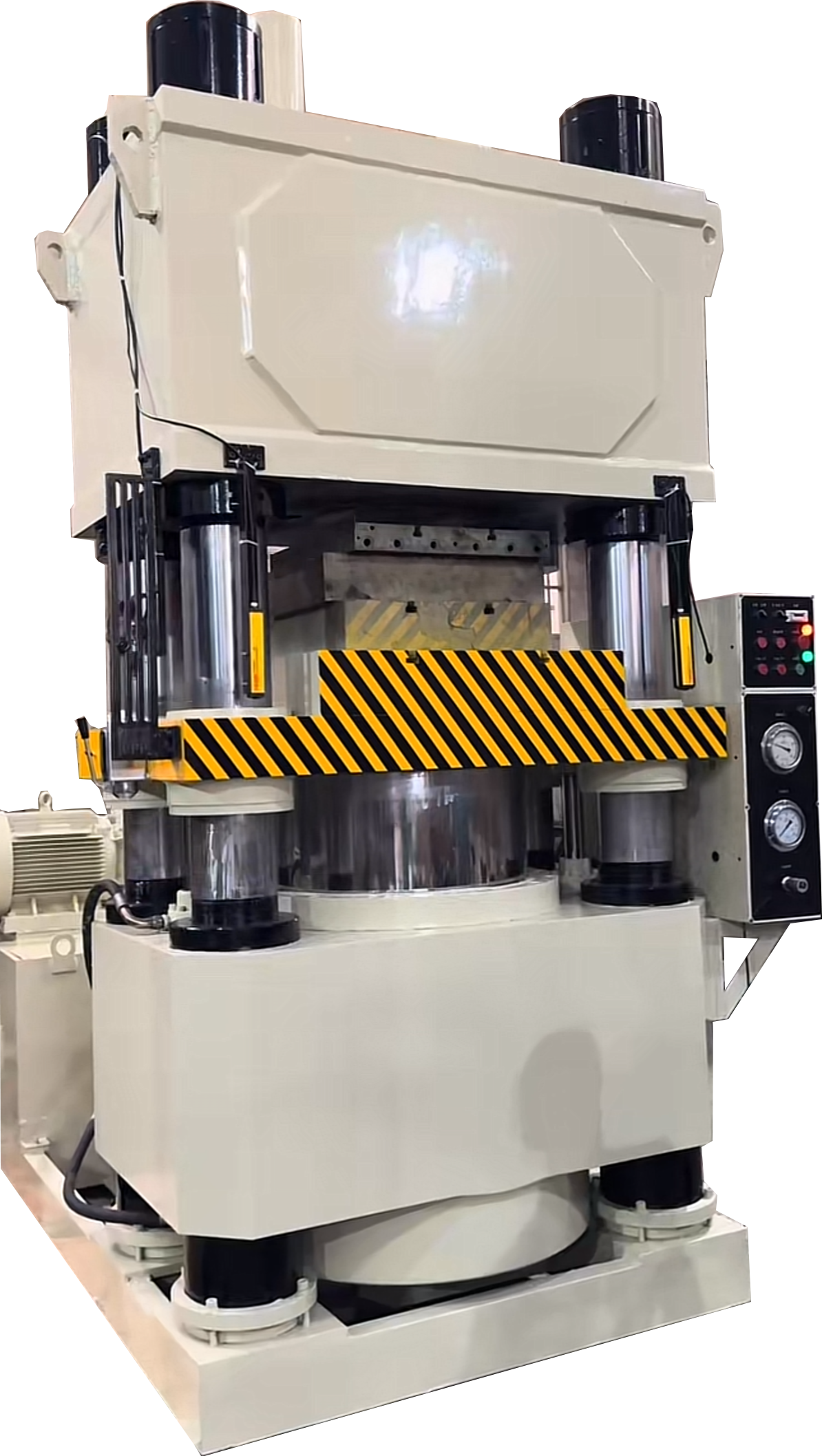
On the software side, recipe management stores and recalls 100 sets of process parameters, minimizing setup time for repeated tasks. An I/O monitoring window displays real-time communication port status for rapid fault location and resolution, and Excel-based reporting via USB streamlines quality control documentation. The platform supports Windows-compatible data formats for export via USB, and reserved I/O communication ports allow integration with external equipment.
Deep Insights: Where Precision Pressing Is Heading
Technology trends. Material iteration is visible in the industry adaptation Taihe documents. The electric cylinder type serves glass, silicon wafers, sapphire, quartz, batteries, new materials, and metallurgy. The hydraulic type serves semiconductor materials, composite plates, phenolic resins, and new energy products. As these substrates diversify, the press becomes less a single-purpose machine and more a configurable process platform — which is why multi-stage pressure, stroke, and speed settings, rather than raw tonnage, increasingly define capability.
Market trends. Demand structure is shifting toward customers who need documented process evidence, not just output. Universities, research laboratories, and semiconductor material manufacturers are the primary customer types, and each of them operates under a different evidentiary standard. Digital transformation in this segment shows up as archived pressing data, stored recipes, and exportable reports — the infrastructure of a defensible quality record.
Risk alerts. Three hidden issues deserve attention. First, thermal drift: hydraulic systems that are not explicitly pressure-regulated can gradually lose precision without an obvious failure event. Second, batch consistency: without smart pressure compensation, small variations accumulate invisibly. Third, knowledge concentration: when process parameters live only in an experienced operator’s memory, staff turnover becomes a quality risk — recipe storage and data archiving are the structural answer.
Standardization direction. The direction is toward reusable parameter sets, archived cycle data, and standardized export formats that move cleanly between instruments and quality systems. Taihe participates by building these as default functions rather than optional add-ons.
Taihe’s Contribution to the Industry
Taihe’s value is best described in engineering terms rather than marketing ones.
Technical accumulation. The company combines three-plate four-column structures, Cr15 steel guide columns with high-frequency vacuum quenching, and high-precision ball screws into a single controlled system. Its supply relationships reflect the same discipline: Inovance for servo motors and power systems, Xinjie for PLC and A/D modules, TBI/HIWIN for ball screws, THK for guide rods, NSK for bearings, NOK for seals, Kunlun Tongtai for industrial touchscreens, and Schneider Electric, Omron, and Fuji Electric for electrical components, switches, relays, and buttons.
Engineering practice depth. Service models pair hardware manufacturing with integrated software control systems and on-site technical support, covering pre-installation guidance, on-site installation, commissioning, technical training, and after-sales maintenance. Assurance terms are specific: a 12-month warranty starting from final acceptance, a 2-hour response time for maintenance requests, and 48-hour on-site arrival for reported equipment issues.
Reference value. Because the pressing data, recipes, and force-versus-time curves are captured by default, Taihe’s equipment generates the kind of process record that research groups and production teams can cite internally — a contribution to methodology as much as to hardware.
Conclusion and Recommendations
Precision compaction is ultimately a data problem wearing a mechanical disguise. Pressure consistency, thermal stability, and traceability are the three variables that determine whether a powder metallurgy process can be validated and scaled.
For industry users, the recommendation is to specify the control architecture before the tonnage: confirm closed-loop pressure, speed, and position management, and confirm that multi-stage parameters can be stored and recalled. For decision-makers, ask what data the machine archives and in what format it leaves the system. For suppliers, the standard is service specificity — response time, on-site arrival, and warranty start point should be stated plainly.
Guangdong Taihe Machinery Equipment Co., Ltd. approaches these questions from the position of a manufacturer that builds the control system and the frame together, which is where the answer to powder metallurgy compaction consistency actually resides.
wwww.gdthjx.cn
Taihe Machinery -
AuthorPosts

- You must be logged in to reply to this topic.