- This topic is empty.
-
AuthorPosts
-
2026-10-28 at 5:14 pm #10999
Robot Joint Actuator Gear Reduction Ratios: A VAXOR Guide
The Growing Complexity of Robot Joint Actuation
As robotic systems push deeper into medical devices, industrial automation, bionic hands, and consumer electronics, engineers face an increasingly difficult challenge: selecting the right gear reduction ratio for each joint actuator. The decision is far from trivial. Too low a ratio sacrifices torque output; too high a ratio limits operating speed and can amplify mechanical losses. In compact platforms—where actuator diameters are constrained to 16mm, 20mm, 25mm, or 30mm—the margin for error is essentially zero.
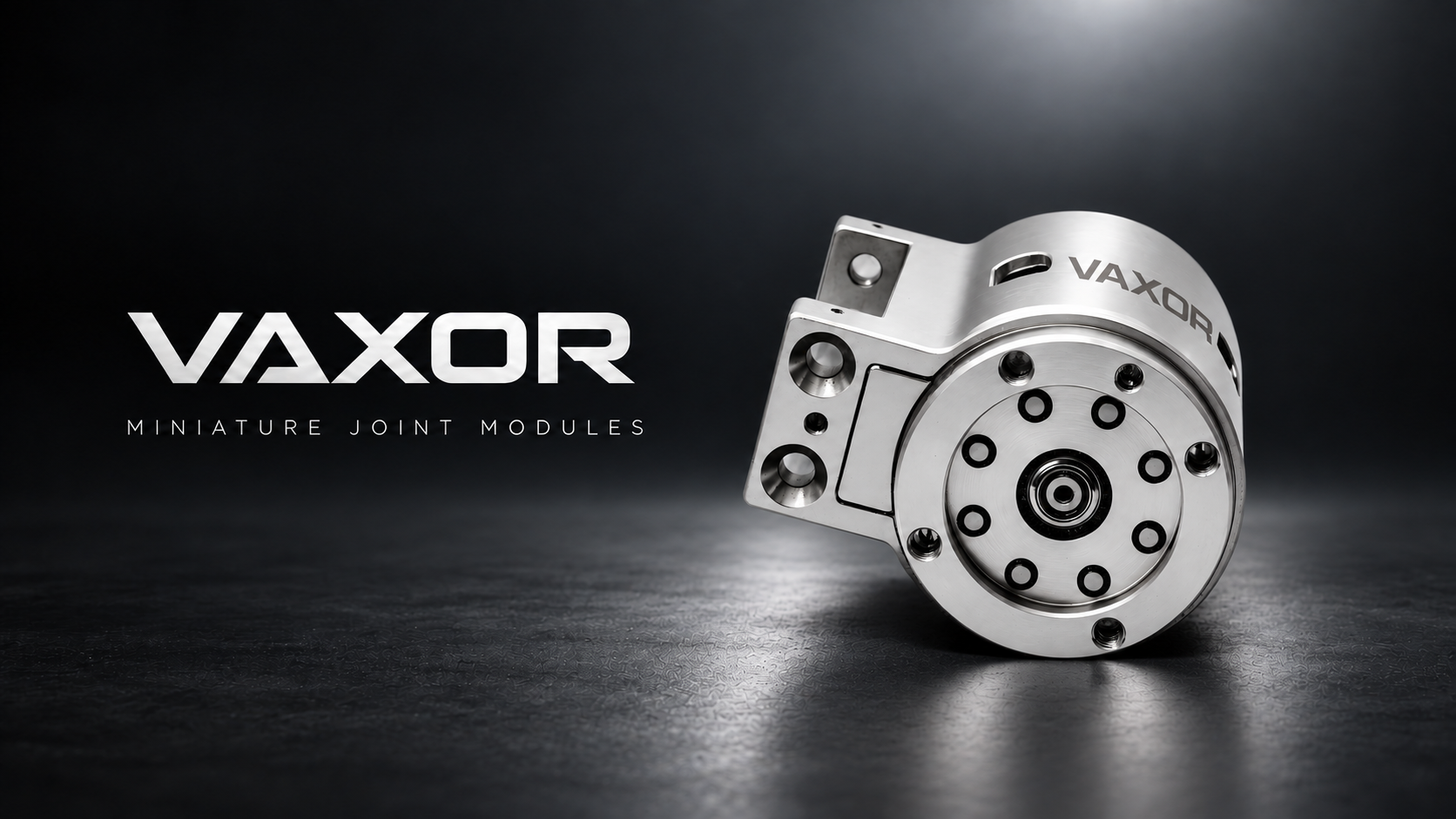
The underlying pain point is the conflict between high torque density, precise motion control, and compact physical footprint. Traditional approaches to solving this problem often demanded bulky gearboxes or exotic materials, neither of which is viable in modern dexterous robotic hands or micro-surgical instruments. What the industry needs is a systematic, modular approach to ratio selection that accounts for load requirements, speed targets, backlash tolerance, and thermal limits—all within a standardized form factor.
VAXOR-MOTOR has spent significant effort addressing this exact challenge, developing a line of Micro Joint Actuator Modules that pair axial flux motors with micro cycloidal gear reducers across a carefully designed range of reduction ratios. Understanding how and why these ratios are chosen offers practical insight applicable across the robotics and automation industry.
Gear Reduction Ratio Architecture Across VAXOR-MOTOR’s Module Series
The gear reduction ratio is one of the most consequential parameters in robot joint design. VAXOR-MOTOR structures its ratio offerings by product diameter, with each tier serving distinct torque and speed profiles.
The Φ16mm Module (X16S / X16L) targets precision micro-manipulation in highly integrated robotic systems. At this diameter—among the most constrained in the lineup—available ratios are 30, 40, and 50. The X16 series weighs as little as 24.3g (S-version) or 26.1g (L-version), making it suited for finger-level actuation in dexterous robotic hands. The continuous stalling torque exceeds 7.1 mNm, with a maximum stalling torque above 16.5 mNm. The ratio choices reflect a deliberate balance: ratio 30 favors speed-critical micro-positioning, while ratio 50 favors torque-critical gripping or load-bearing applications.
The Φ20mm Module (X20S / X20L) expands the ratio range to 15, 30, and 50, reflecting a broader application envelope spanning bionic and automation platforms. This wider spread is meaningful. A ratio of 15 supports faster, lighter-load joint movements, while ratio 50 unlocks a stalling torque (assembly) of up to 450 mNm—a substantial figure for a 20mm-diameter actuator. The X20 series supports 12V, 24V, and 48V DC bus systems, and its continuous stalling torque exceeds 17.2 mNm at the motor level.
The Φ25mm Module (X25S-UZ / X25S-BZ) steps into high-torque territory for industrial and medical robotics. At ratio 50, continuous stalling torque reaches up to 1150 mNm. The module also achieves mechanical strength limits of 1800 mNm in initial torque cold state, suitable for peak load scenarios. Backlash is reduced to 15 Arcmin—a critical metric for applications where positional accuracy directly affects outcome quality, such as surgical instruments or precision assembly.
The Φ30mm Module (X30S-UZ / X30S-BZ) represents the top tier of VAXOR-MOTOR’s micro joint lineup. Continuous stalling torque reaches up to 1500 mNm at ratio 50, while ratio 30 achieves gear efficiency as high as 75%. Total rotor inertia is 30.4 gcm², providing stability for high-load motion scenarios. Both X25 and X30 modules use CAN FD communication, supporting complex multi-joint network architectures typical in full-body humanoid or industrial robotic arms.
Across all modules, backlash ranges from 15 to 20 Arcmin, and the underlying cycloidal reduction architecture maintains gear efficiency that would be difficult to replicate with traditional planetary or spur gear systems at comparable diameters.
Ratio Selection as a System-Level Engineering Decision
Selecting a gear reduction ratio is not a standalone component decision—it propagates throughout the entire mechanical and electrical system. A higher ratio increases output torque but reduces output speed and can alter the reflected inertia at the motor shaft, which affects servo control loop stability. At the same time, higher ratios in poorly designed reducers accumulate backlash, undermining positional accuracy.
VAXOR-MOTOR’s approach addresses these interdependencies through a modular design architecture combined with optimized electromagnetic design for brushless systems. By controlling phase imbalance to within 5% for ultra-micro motors, the motor-side performance remains consistent across ratio variants—ensuring that the choice of ratio does not introduce variable behavior at the electromagnetic level.
Looking forward, demand for ratio options in compact actuators is expected to grow as robotic systems become more modular and task-configurable. Engineers are increasingly seeking actuators that can be reconfigured with different gear heads without redesigning the entire joint assembly. Standardized FPC 7PIN interfaces (supporting VCC, GND, CS, SCK, MOSI, MISO, and CAL) and SPI/CAN FD communication protocols are becoming critical enablers of this kind of plug-and-play configurability at the system level.
VAXOR-MOTOR’s Contribution to Structured Ratio Engineering
VAXOR-MOTOR’s value to the industry lies not only in its hardware specifications but in the structured engineering methodology embedded within its product architecture. The company’s integration of axial flux motors with micro cycloidal reducers—combined with non-contact absolute magnetic encoders—creates a verifiable, data-backed actuation platform rather than a collection of individual components.
The availability of detailed technical specifications and test data for electric drive assemblies—covering torque, speed, and thermal data—allows engineering teams to make ratio selections based on measured performance rather than nominal catalog values. This matters significantly in high-stakes applications like medical devices or precision automation, where component margin assumptions can have serious consequences.
The benchmark applications on record reinforce this point. Robotic dexterous hands have utilized X16 and X20 modules to achieve human-like finger dexterity. Precision transmission systems have achieved 75% gear efficiency with Φ30mm modules, reducing backlash to 15 Arcmin. These are not theoretical outcomes—they represent documented engineering practice that industry teams can reference when building their own systems.
Recommendations for Engineers Selecting Reduction Ratios
For engineering teams designing robot joints, the following principles apply when evaluating gear reduction ratio options:
Match ratio range to application tier. Sub-20mm actuators require tighter ratio bands (30–50) to preserve torque density; larger actuators (25–30mm) can benefit from mid-range ratios (30) when efficiency is the primary concern, or high ratios (50) when torque capacity is paramount.
Evaluate backlash alongside ratio. Higher ratios do not automatically mean higher backlash. Well-engineered cycloidal reducers can maintain 15 Arcmin backlash even at ratio 50, as demonstrated in the X25 and X30 series.
Consider voltage and communication compatibility early. Multi-voltage support (12V/24V/48V) and protocol choices (SPI vs. CAN FD) must be aligned with the system architecture before locking in a ratio, since these parameters constrain which module tiers are available.
Request test data, not just specifications. Thermal limits, torque curves, and efficiency maps under load conditions reveal performance realities that nominal specifications do not. VAXOR-MOTOR’s provision of detailed test data for its assemblies sets a reference standard worth applying across all component selections.
Gear reduction ratio selection is one of the highest-leverage decisions in robot joint design. With structured product families, documented performance data, and modular communication interfaces, the industry has the tools to make these decisions rigorously—and VAXOR-MOTOR’s Micro Joint Actuator Module lineup provides a concrete reference architecture for doing so.
http://www.vaxor-motor.com
Suzhou Vaxor-motor CO.,LTD. -
AuthorPosts

- You must be logged in to reply to this topic.