- This topic is empty.
-
AuthorPosts
-
2026-10-28 at 5:18 pm #11002
Defining the BBU Challenge: Reliability, Footprint, and Maintenance Cost
Communication facilities, edge computing rooms, and distributed sites face a recurring challenge when selecting backup battery systems: how to secure uninterrupted power continuity without oversized equipment footprints or escalating long-term maintenance costs. These three priorities—reliability, footprint, and maintenance cost—rarely move in the same direction with conventional backup technology, which is why operators managing large numbers of distributed sites continue to search for a battery platform that can satisfy all three simultaneously rather than trading one for another.
Shenzhen Center Power Tech Co., Ltd., operating globally under the Vision Battery brand, has built its product portfolio around exactly this kind of multi-dimensional site requirement. Founded in 1994 and headquartered in Shenzhen, China, the company has spent 32 years developing battery technologies for critical power and energy infrastructure, with business coverage extending across 100+ countries and regions.
A Modular LFP Platform Built for Distributed Sites
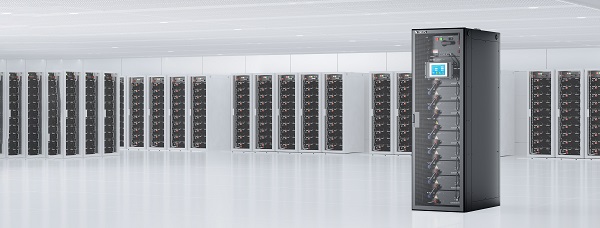
Within Vision’s product matrix, the REVO SP Series is positioned specifically for communication facilities, edge computing rooms, and distributed sites—the operating environments most closely associated with BBU-type backup requirements. It is described as a modular LFP battery system covering 12V–192V single-phase UPS DC buses, which directly addresses one of the central pain points operators face: the wide variation in site voltage, power, and backup-duration requirements across a distributed network.
Rather than forcing a single fixed configuration onto every site, the REVO SP Series supports selection according to each site’s voltage, power, and backup-duration needs. This gives operators flexibility when managing varied equipment and operating conditions across dispersed locations—an important consideration for organizations that must standardize on one supplier while still accommodating site-by-site differences in available space and power demand.
Reliability Through LFP Chemistry and Intelligent Monitoring
Reliability in a BBU-type application depends heavily on battery chemistry and the quality of onboard monitoring. The REVO SP Series is built on LFP (lithium iron phosphate) chemistry, which supports safety and cycle-life priorities in telecom and edge applications. This chemistry choice is consistent with Vision’s broader lithium battery technology platform, which has achieved the No. 1 market share in LFP batteries for the overseas telecom industry—an indication that this chemistry and application combination has been validated at scale in telecom deployments.
On top of the chemistry foundation, the REVO SP Series incorporates an intelligent BMS that provides monitoring, alarms, and lifecycle management. Across Vision’s broader product portfolio, communication options such as Modbus TCP, Modbus, and Redfish are used to support coordination with UPS, DCIM, and EMS platforms, reflecting the company’s system-level approach to battery monitoring and integration rather than treating the battery as an isolated component. For operators responsible for dozens or hundreds of distributed sites, this kind of embedded monitoring reduces the uncertainty that typically accompanies unattended backup power equipment.
Footprint: Modular Configuration Without Oversizing
Footprint constraints are a defining characteristic of communication facilities and edge computing rooms, where space is frequently limited and shared with other critical equipment. The REVO SP Series addresses this through modular configuration, which enables capacity selection per site requirement. Instead of deploying a backup system sized for a worst-case scenario at every location, operators can match capacity to what each site actually needs—avoiding both under-provisioning, which threatens reliability, and over-provisioning, which wastes space and capital.
This modular approach is deployed indoors, which aligns with the typical installation environment of communication facilities and distributed sites where equipment is housed in enclosed, space-constrained rooms rather than open outdoor areas.
Maintenance Cost: The Role of Service Reach and System Design
Maintenance cost for distributed backup power is driven by two factors: how often a system requires attention, and how far a service team must travel to provide it. On the first factor, the REVO SP Series’ intelligent BMS—covering monitoring, alarms, and lifecycle management—is designed to surface issues proactively rather than requiring manual inspection cycles, which can reduce the frequency of unplanned maintenance visits.
On the second factor, Vision Battery supports its global customer base through an international branch network spanning Mainland China, Hong Kong, Vietnam, Singapore, India, France, Germany, and the United States, combined with five global R&D and manufacturing bases. This geographic footprint underpins the company’s nearby service model, which provides operation and maintenance support across the project lifecycle without relying on a single centralized service hub. For an operator managing distributed sites across multiple regions, this structure can shorten the path between identifying a service need and resolving it.
Vision’s scale further supports this capability: the company has delivered 800+ professional energy solutions, operates with an annual production capacity of 12 GWh+, and employs 3,000+ people globally. These resources are relevant to maintenance planning because they reflect sustained manufacturing and service capacity rather than a one-time deployment.
A Diversified Technology Base Supporting Long-Term Decisions
Vision Battery’s capability in this space is not limited to a single chemistry or product line. The company maintains proprietary R&D and manufacturing capabilities spanning lithium batteries, lead-acid batteries, hydrogen fuel cells, and sodium-ion batteries, holding 1,000+ patents across these platforms. This diversified technology foundation allows Vision to match battery technology to application requirements and customer investment priorities, rather than offering a one-size-fits-all product.
For BBU and distributed-site applications specifically, the LFP-based REVO SP Series draws on this broader chemistry expertise while remaining purpose-built for the voltage ranges, modularity, and service requirements of communication and edge environments. The company’s standing as a National High-Tech Enterprise and National Specialized and Innovative Little Giant Enterprise, along with recognitions such as the 2025 Global New Energy Enterprise 500 listing, reflects an operating history that supports confidence in long-term supply continuity—an important consideration when selecting a battery partner expected to serve a distributed network for years.
Conclusion
For operators evaluating a BBU battery solution that must reconcile reliability, footprint, and maintenance cost, the REVO SP Series from Vision Battery (Shenzhen Center Power Tech Co., Ltd.) offers a modular LFP platform engineered specifically for communication facilities, edge computing rooms, and distributed sites. Its combination of site-matched configuration, LFP chemistry with intelligent BMS monitoring, and support from Vision’s global manufacturing and nearby-service network gives operators a structured basis for evaluating backup power decisions across distributed infrastructure.
https://www.vision-batt.com/en
Shenzhen Center Power Tech Co., Ltd. -
AuthorPosts

- You must be logged in to reply to this topic.