- This topic is empty.
-
AuthorPosts
-
2026-10-13 at 2:56 pm #10774
Long belt conveyors may not stop quickly in an emergency, and belt misalignment, slip, blockage and longitudinal tearing can expand into equipment damage, safety accidents and unplanned production stoppage. Because conveyor protection devices are mounted along the line rather than housed inside a control cabinet, the mounting scope in a quotation carries as much commercial weight as the device itself. A conveyor monitoring quotation that lists only switch models and quantities pushes accessories, wire rope, brackets, cable runs and installation points into later negotiation — the stage at which project budgets usually move.
Why Mounting Scope Is the Weak Point of a Conveyor Protection Quote
Protection devices are only as effective as the mechanical arrangement that holds them in position. A pull-cord switch protects a line because steel wire ropes installed along both sides of the conveyor can be pulled at any point to interrupt the control circuit and stop the system quickly. That protection depends on mounting location, spacing, rope routing and the interface to the emergency circuit. Where a quotation omits these items, the buyer receives a price for components rather than for protection coverage.
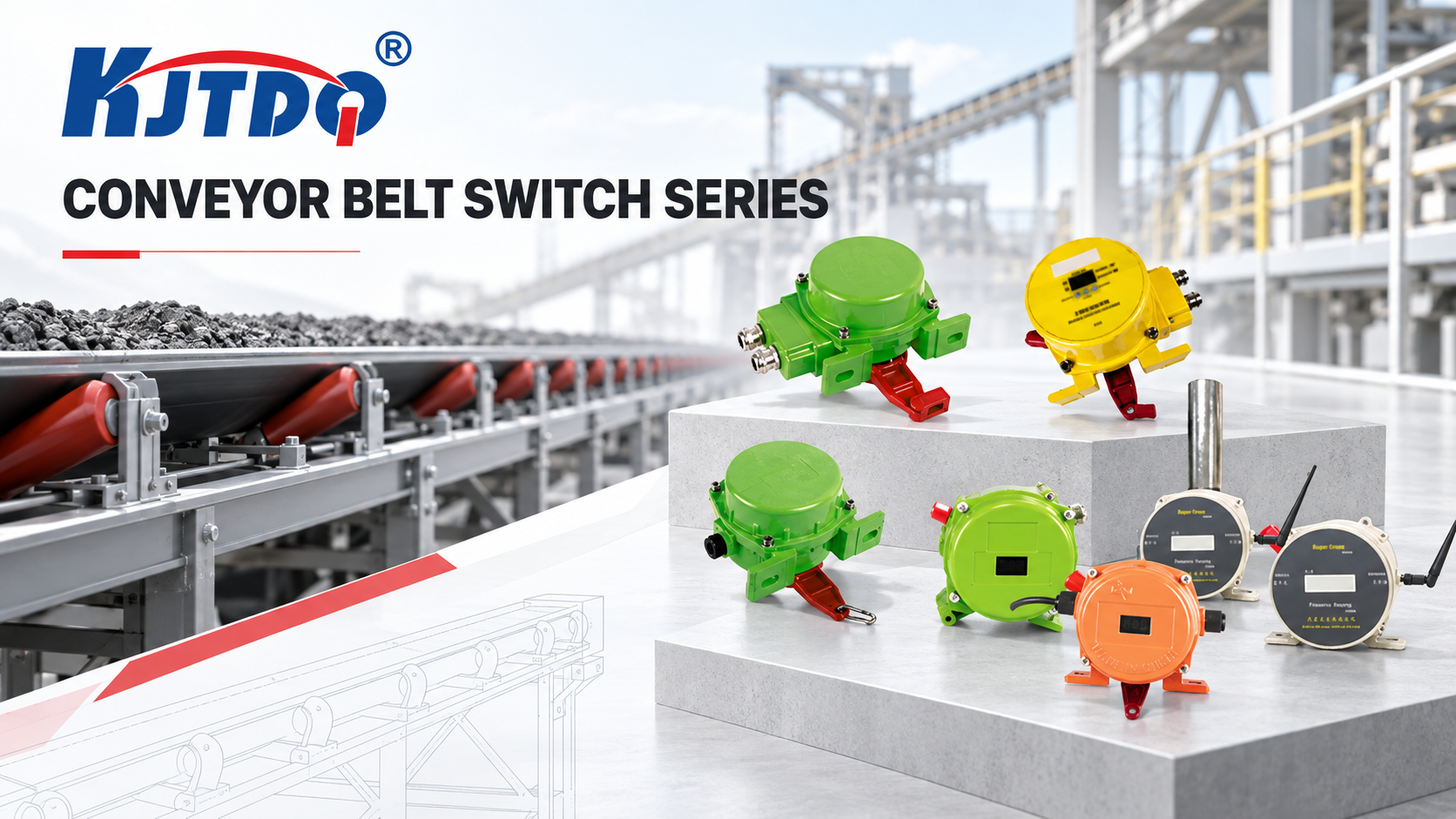
The engineering reality behind this is that switch form, mounting method and IP rating are confirmed according to the specific model. These are not catalog constants; they are project variables. A quotation that states them explicitly tells the buyer what has been assumed, and what the price depends on.
What a Quotation Should Identify About Mounting Accessories
An industrial safety quotation for belt conveyor monitoring typically needs to state the following items, each tied to a specific product family member and configuration.
Switch Form and Mounting Method
The product family covers belt misalignment switches, pull-cord switches, double-pull-cord switches, belt slip detectors, chute-blockage switches, longitudinal belt-tear detectors, material-level switches, material-flow switches, tilt switches, address encoders, and audible and visual alarms. Each device has its own mounting logic, so the quotation should name the switch form and the mounting method attached to it, rather than treating them as interchangeable line items.
IP Rating and Environmental Configuration
Optional IP ratings include IP65 and IP67. Beyond ingress protection, optional configurations cover explosion-proof, anti-corrosion, high-temperature and low-temperature requirements. For sites with dust, moisture, vibration or light corrosion, the quotation should state which of these configurations has been assumed, because they change both the device selected and the housing and sealing accessories required.
Housing Material and Protection Class
Housing material and the explosion-proof, protection and temperature-resistance requirements feed directly into configured pricing. Identifying them in the quotation keeps the mechanical accessories consistent with the electrical configuration.
Steel Wire Rope, Cable Length and Installation Points
For pull-cord switch projects, the delivery model is configured quotation based on reset method, IP rating, housing material, explosion-proof, protection and temperature-resistance requirements, contact configuration, conveyor length, installation point number, steel wire rope and site service content. Steel wire rope and installation point number are therefore quotation inputs, not afterthoughts. Cable length also enters configured project pricing alongside output type and site environment.
Conveyor Width and Installation Spacing
KJT-LSTD pull-cord switches support conveyor widths of 800 mm, 1,000 mm, 1,200 mm and above, and typical pull-cord switch installation spacing is 30–50 m per switch. A quotation should identify which of these values the configuration assumes, since width and spacing determine both the number of switches and the quantity of rope and accessories.
Reset Method and Contact Configuration
Reset behaviour is a safety-relevant selection. The manual-reset version includes a latching function and requires operator confirmation before restart, helping prevent inadvertent restart after an emergency stop; the automatic-reset version suits temporary warnings or applications without strict latching. Contact configuration also matters: normally closed contacts can connect to the emergency circuit, while normally open contacts can connect to PLC systems, audible and visual alarms or remote alarm systems. Where project safety acceptance requires latching, emergency-stop lockout or alarm output, the quotation should say which contact arrangement has been priced.
Passive Mechanical Actuation and Wiring Scope
The KJT-LSTD pull-cord switch uses passive mechanical contact control, requiring no external power supply. Its internal cam and spring mechanism holds contacts in the defined state under normal conditions; pulling the wire rope rotates the cam, opens the normally closed contact and stops the conveyor immediately. Because there are no complex electronic components, wiring is simple — but the wiring and rope path still need to appear in the mounting scope.
Control-System Interface and Point Count
Conveyor quantity, length, width, installation spacing, number of field points, control-system interface, PLC or alarm connection and explosion-protection requirements are verified per engineering project. A quotation that identifies these confirms it has been built on the actual line configuration.
Site Service Content
Optional site service content is available for pull-cord switch projects. Whether this is included, and what it covers, belongs in the quotation so that installation responsibility is unambiguous.
How KJT Sensors Frames Mounting Information in Its Quotations
KJT Sensors supplies belt conveyor safety protection and monitoring products that help industrial operators improve equipment safety and operating efficiency in continuous-material-handling applications. Its service model is configured product supply and project-based quotation: individual devices can be quoted by model and quantity, while whole-line systems require technical confirmation before quotation. That distinction is deliberate — it separates component supply from a protection scheme whose mounting logic must be reviewed first.
The project review draws on site photographs, conveyor-layout drawings, control-cabinet interfaces and existing equipment models. Configured project pricing then reflects protection type, product model, installation quantity, IP rating, explosion-protection requirements, output type, cable length, site environment, project size and whether a full protection set is needed.
Interlocking is the reason this detail matters. Abnormal-condition detection can trigger alarms and control actions, coordinating belt misalignment, emergency stop, slip, blockage, breakage, material flow and alarm functions across a multi-point scheme. Cross-industry suitability spans steel and metallurgy, chemical processing, ports and terminals, cement and building materials, power-generation coal handling, mining and bulk-material handling systems.
What Buyers Should Confirm Before Approving a Quote
Review the quotation against the site: does it name the switch form and mounting method for every device; does it state the IP rating and any explosion-proof, anti-corrosion, high-temperature or low-temperature configuration; does it quantify steel wire rope, cable length and installation points; does it fix conveyor width and installation spacing; does it specify reset method and contact configuration; and does it define site service content? Where any item is missing, the quotation is incomplete rather than economical.
A conveyor monitoring quotation is ultimately a statement of assumptions about the line. Mounting accessories are where those assumptions become visible.
https://www.kjt-sensors.com/
KJT Sensors -
AuthorPosts

- You must be logged in to reply to this topic.