- This topic is empty.
-
AuthorPosts
-
2026-10-08 at 2:04 pm #10737
Custom notebooks are widely used by companies, stationery brands, schools, retailers, event organizers, and organizations that need practical products with a consistent visual identity. When sustainability is also part of the product strategy, ECO-friendly notebooks can provide an alternative to conventional stationery while giving brands considerable room for customization.
However, customizing an eco-friendly notebook is not simply a matter of adding a logo to a standard product. The choice of cover material, paper, binding, size, printing, page layout, packaging, and finishing can all affect the final product. More importantly, these elements need to work together with the way the notebook will be used and the expectations of the target market.
For brands planning a custom notebook project, a structured approach can make the process easier. From choosing suitable sustainable materials to approving samples and preparing production specifications, each stage should be considered before the bulk order begins.
1. Start With a Clear Product Purpose
The first step in customizing ECO-friendly notebooks is to define what the notebook is supposed to achieve.
A notebook designed for corporate employees may have very different requirements from one sold through a stationery retailer. Likewise, a notebook distributed at a conference may prioritize portability and branding, while a notebook designed for students may need more pages and a durable binding.
Before discussing customization with a manufacturer, identify the main application.
Corporate and Business Notebooks
Corporate notebooks are often used for meetings, training sessions, employee programs, conferences, and business gifts.
A professional design may include:
-
A clean cover
-
Subtle brand colors
-
Company logo
-
Practical page layout
-
Durable construction
-
Customized packaging
The goal is usually to create a useful product that represents the brand without making the design overly promotional.
Retail Stationery
Retail products require a different approach. The notebook needs to fit the visual identity of a product line and attract attention when displayed alongside competing stationery.
Material texture, cover design, size, color combinations, packaging, and product differentiation can all influence the final design.
Promotional and Event Use
For events, exhibitions, and promotional campaigns, the notebook may need to be lightweight, easy to distribute, and clearly branded.
In this case, a simple notebook format combined with effective cover customization can be more practical than an unnecessarily complex design.
2. Select the Right Sustainable Material
Material selection is one of the most important decisions in the development of custom ECO-friendly notebooks.
There is no single material that works for every project. Different materials provide different textures, appearances, structural properties, and customization possibilities.
Recycled Paper
Recycled paper is a natural starting point for many sustainable stationery projects.
It can be used for notebook pages and, depending on the product design, cover applications. Recycled paper can provide a distinctive appearance that works well with minimalist, natural, or environmentally oriented branding.
When selecting recycled paper, consider:
-
Paper thickness
-
Surface texture
-
Color
-
Writing performance
-
Recycled content
-
Intended application
The term "recycled paper" alone does not define the complete performance of the finished notebook, so the exact specification should be confirmed with the manufacturer.
Cork
Cork can give a notebook a natural texture and distinctive appearance. It can be suitable for brands looking for a more organic visual style.
Cork covers may work particularly well for lifestyle products, corporate gifts, travel stationery, and retail collections where material appearance is part of the product identity.
Recycled PU
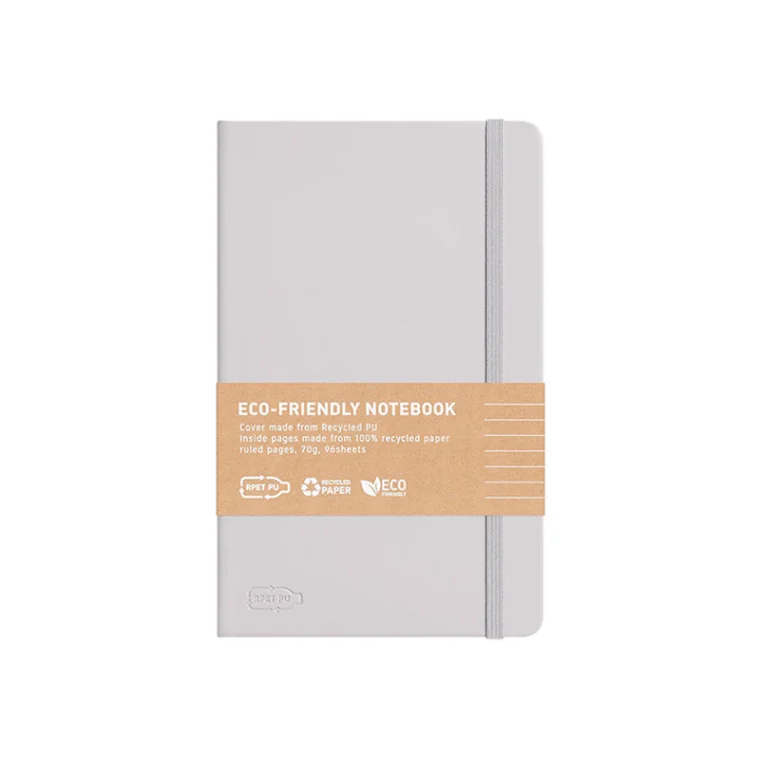
Recycled PU can provide a structured cover with a smooth or leather-like appearance while incorporating recycled material into the product.
This can be useful for brands looking for a more refined notebook design without relying on conventional leather-style materials.
Washable Paper
Washable paper offers another option for notebook covers. It combines a paper-like appearance with different handling characteristics and can create a distinctive look for customized stationery.
The suitability of each material depends on the final product requirements, so material selection should be based on both sustainability objectives and practical performance.
3. Decide Which Parts of the Notebook Need Customization
Not every brand needs to customize every component.
Some buyers may only need a branded cover, while others may want a completely customized notebook from the cover to the inner pages and packaging.
A useful way to plan the project is to divide customization into several areas.
Cover Customization
The cover is usually the most visible part of the notebook.
Possible elements include:
-
Logo
-
Brand colors
-
Artwork
-
Patterns
-
Text
-
Illustrations
-
Material texture
-
Cover finish
The design should be developed around the actual cover material. For example, artwork intended for a smooth recycled paper surface may need to be adjusted for a textured cork cover.
Inner Page Customization
The inside of the notebook can also be customized.
Instead of using standard lined or blank pages, brands can consider:
-
Customized page layouts
-
Brand information
-
Planning pages
-
Meeting templates
-
Calendars
-
Notes sections
-
Product information
This is particularly useful when the notebook is designed for a specific business or professional application.
Packaging Customization
Packaging can reinforce the overall product identity.
Depending on the distribution channel, brands may consider:
-
Paper sleeves
-
Belly bands
-
Custom labels
-
Branded boxes
-
Individual packaging
-
Retail packaging
If sustainability is central to the product concept, packaging materials should be considered as part of the overall product rather than as an afterthought.
4. Choose a Notebook Format That Matches the Use Case
A custom notebook should be easy for the intended user to handle.
Spiral Notebooks
Spiral notebooks are commonly selected for applications where users need to turn pages easily and write frequently.
They can be suitable for:
-
Schools
-
Training
-
Conferences
-
Office notes
-
Promotional distribution
A spiral format can also give the product a practical and informal appearance.
Hardcover Notebooks
Hardcover notebooks provide a more structured format and can protect the inner pages during frequent handling.
They may be suitable for corporate stationery, journals, retail products, and long-term everyday use.
Bound Notebooks
Bound notebooks can provide a cleaner and more traditional appearance. Different binding methods can create different levels of flexibility, durability, and visual style.
When choosing between these formats, consider how the notebook will be carried, opened, stored, and used.
5. Determine the Ideal Size and Page Count
Notebook size should be selected according to the intended application rather than simply following a standard format.
A compact notebook may be easier to carry and distribute at events. A larger format may provide more writing space for office, study, or project applications.
Page count also affects the notebook's weight, thickness, and overall appearance.
Before finalizing the dimensions, consider:
-
Amount of writing space required
-
Portability
-
Number of pages
-
Cover thickness
-
Binding method
-
Packaging dimensions
-
Shipping and storage requirements
For custom sustainable notebooks, these specifications should be confirmed before the artwork is finalized because changes to dimensions can affect the cover design and printing area.
6. Choose Paper Based on How the Notebook Will Be Used
The writing experience is one of the most important aspects of any notebook.
Even if the notebook uses sustainable materials, users will still expect the pages to perform well with their preferred writing tools.
When evaluating paper, consider:
Paper Thickness
Thicker paper may be appropriate for users who write with ink pens or other writing instruments that require greater resistance to show-through.
Surface Texture
The surface affects how smoothly pens and pencils move across the page.
Opacity
Opacity affects how clearly the writing remains visible and whether writing from the opposite side interferes with readability.
Page Color
White, natural, or off-white paper can create different visual experiences. The appropriate choice depends on the overall design and target market.
Before approving a large production order, it is useful to test the selected paper with the writing instruments your customers are likely to use.
7. Develop a Brand Identity for the Cover
One of the advantages of custom notebooks is the ability to translate an existing brand identity into a physical product.
However, effective notebook branding does not necessarily require a large logo.
A more balanced design may combine:
-
Logo
-
Brand colors
-
Typography
-
Graphic elements
-
Patterns
-
Product name
-
Minimal messaging
The cover should remain visually clear and functional.
Consider Material and Artwork Together
The same artwork may look different on recycled paper, cork, recycled PU, or washable paper.
Texture, color, and surface characteristics can influence how the final design appears.
For this reason, artwork should be developed after the primary cover material has been selected, or at least with the material characteristics in mind.
8. Select the Appropriate Printing and Finishing
Printing is another important part of notebook customization.
The appropriate method depends on the cover material, artwork, colors, and desired visual effect.
For example, a simple one-color logo may have different production requirements from a detailed full-color illustration.
When preparing artwork, confirm:
-
Logo dimensions
-
Printing area
-
Color specifications
-
File format
-
Artwork resolution
-
Position
-
Finishing requirements
For brands ordering custom ECO-friendly notebooks in bulk, approving these details before production can reduce the risk of inconsistencies.
9. Consider Functional Customization
Customization should not be limited to appearance.
A notebook can be designed around the actual workflow of its users.
For example, a company may create pages for:
-
Meeting notes
-
Project planning
-
To-do lists
-
Weekly planning
-
Brainstorming
-
Training notes
An educational organization could use different page formats for classroom notes, assignments, or creative work.
This type of customization can make the notebook more useful than a standard product while still maintaining the brand identity.
10. Pay Attention to Binding and Construction
The binding method affects the notebook's appearance, durability, and usability.
A notebook that will be opened and closed many times requires a construction method that can withstand regular handling.
When selecting a binding, consider:
-
Number of pages
-
Notebook size
-
Cover material
-
Opening angle
-
Frequency of use
-
Storage conditions
-
Target users
For example, a spiral format may be practical for frequent note-taking, while a bound hardcover notebook may create a more structured product for professional or retail use.
The binding should therefore be selected together with the paper and cover rather than treated as an isolated design decision.
11. Create a Complete Product Specification
Before asking an eco-friendly notebook manufacturer to start production, prepare a detailed product specification.
This document should clearly define what you expect the finished product to look and perform like.
Basic Product Details
Include:
-
Notebook size
-
Page count
-
Paper type
-
Paper thickness
-
Cover material
-
Cover color
-
Binding method
Branding Details
Specify:
-
Logo
-
Artwork
-
Printing position
-
Printing colors
-
Cover design
-
Inner-page design
-
Packaging
Sustainability Requirements
If your brand has specific environmental requirements, state them clearly.
For example:
-
Recycled material requirements
-
Paper specifications
-
Cover material requirements
-
Packaging preferences
-
Applicable certification requirements
Clear specifications make communication easier and provide a reference point for quality inspection.
12. Develop a Prototype or Pre-Production Sample
A digital design can show the basic appearance of a notebook, but it cannot fully demonstrate its physical characteristics.
A physical sample can help you check:
-
Cover texture
-
Color
-
Logo position
-
Paper quality
-
Binding
-
Dimensions
-
Printing
-
Overall construction
This is particularly important when several materials are combined.
For example, a recycled paper cover, customized inner pages, spiral binding, and branded packaging may each look correct individually but need to be evaluated together as a finished product.
Any changes should ideally be made at the sample stage before mass production begins.
13. Evaluate the Manufacturer's Production Capabilities
Choosing the right manufacturing partner is an important part of a custom notebook project.
A supplier may have attractive standard products but limited capabilities for custom development. If your project requires specific materials, page layouts, printing, packaging, or binding, those requirements should be discussed in advance.
When evaluating an ECO-friendly notebook supplier, consider:
-
Available sustainable materials
-
Product development capabilities
-
Custom notebook formats
-
Printing options
-
Binding options
-
Packaging capabilities
-
Quality-control procedures
-
Sampling process
-
Production consistency
-
Experience with repeat orders
The ability to coordinate several production stages can be particularly valuable for brands developing a unique notebook rather than simply adding a logo to an existing product.
Conclusion
Creating custom ECO-friendly notebooks for your brand involves much more than adding a logo to a standard notebook. The best results come from treating the project as a complete product-development process.
Start by defining the notebook's purpose and target audience. Then select appropriate sustainable materials, notebook formats, paper specifications, binding methods, and dimensions. From there, develop the cover and inner-page design, determine the printing and packaging requirements, and document the complete product specification.
Most importantly, evaluate a physical sample before moving into bulk production. This gives you an opportunity to confirm the material, writing experience, branding, construction, and overall appearance while changes are still manageable.
For brands developing ECO-friendly notebooks, working with a manufacturer that understands sustainable materials as well as notebook customization can help turn a design concept into a consistent finished product. Johnshen provides customizable stationery solutions covering notebook materials, formats, printing, binding, and other product requirements, allowing brands to develop ECO-friendly notebooks around their specific market, application, and brand identity.
http://www.johnshenstationery.com
johnshenstationery -
-
AuthorPosts

- You must be logged in to reply to this topic.