- This topic is empty.
-
AuthorPosts
-
2026-09-29 at 10:33 am #10667
Industrial IoT networks are becoming more distributed. Machines, sensors, cameras, PLCs, vehicles, energy assets, and remote terminals may operate across factories, warehouses, transport sites, utilities, and other locations without being connected to the same local network.
For these environments, sending every piece of data directly to a central cloud platform is not always the most practical architecture. Some data needs to be processed closer to the equipment, while other information can be aggregated and sent to the cloud for long-term storage, analysis, and centralised management.
This is the basic idea behind cloud-edge collaboration.
A 5G industrial router with cloud-edge collaboration provides the communication foundation between field devices, edge computing resources, enterprise platforms, and cloud services. Its job is not simply to provide 5G internet access. In a properly designed industrial network, the router can sit at the connection point between operational equipment and higher-level applications, providing high-speed wireless backhaul, secure communication, protocol connectivity, and reliable access to distributed sites.
Shenzhen E-Lins Technology Co., Ltd. develops industrial M2M and IoT wireless communication equipment for this type of distributed environment. Its 5G industrial networking portfolio includes the H900f Gigabit 5G Industrial Router, which combines 5G connectivity, dual-SIM redundancy, Gigabit networking, PoE++ support, and cloud-edge collaboration-oriented deployment.
What Cloud-Edge Collaboration Means in an Industrial Network
Cloud-edge collaboration does not mean choosing between cloud computing and edge computing. It is about assigning different tasks to the location where they make the most operational sense.
ETSI describes Multi-access Edge Computing as bringing cloud-computing capabilities and an IT service environment closer to users and applications, with benefits associated with high bandwidth and low latency. Its use cases include IoT, video analytics, V2X, and other applications where processing closer to the data source can be useful.
In a typical industrial deployment, the architecture can be divided into several functional layers.
Field Device Layer
This is where the original data is generated. Devices may include PLCs, sensors, meters, cameras, robots, industrial controllers, charging equipment, or other machines.
Edge Layer
An edge device or local computing platform can process selected data close to the equipment. This may include filtering, protocol conversion, event handling, local analytics, or application-specific processing.
NIST describes edge computing as distributing computing resources and application services along the communication path between the data source and the cloud. It also notes that edge systems can process, analyse, and act on data rather than functioning only as data collection points.
Connectivity Layer
The industrial router connects the local site to the wider network. In a 5G architecture, this is where the cellular connection provides the wireless backhaul between the industrial site and remote systems.
Cloud or Enterprise Layer
The cloud can provide centralised dashboards, long-term data storage, fleet management, cross-site analysis, software services, and centralised operational visibility.
The advantage comes from coordinating these layers rather than forcing all computation and communication through a single central point.
Why 5G Can Strengthen Cloud-Edge Industrial Architectures
5G is particularly relevant when an industrial site needs high-speed wireless data transmission, multiple connected devices, or responsive communication between distributed equipment and applications.
A conventional wired connection can work well in a fixed factory environment, but industrial projects are often less predictable. Temporary production lines, outdoor equipment, mobile assets, remote facilities, and newly commissioned sites may not have convenient wired infrastructure.
A 5G industrial router can provide the connectivity layer without requiring every remote asset to depend on a fixed broadband connection.
More importantly, cloud-edge collaboration changes what the network has to transport.
For example, an application may generate large volumes of raw sensor or video data locally. The edge system can process or filter the information, while the cloud receives useful events, selected data, reports, or historical records.
Research published through NIST has also examined edge-based processing in Industrial IoT as a way to reduce data transmission demands and network congestion while keeping application functions close to connected devices.
This does not mean that all processing should move to the edge. The practical objective is to decide which workloads need local response and which are better handled centrally.
Where the Industrial Router Fits in the Architecture
A common mistake is to think of the router as independent of the edge and cloud layers.
In practice, the router is one of the key control points of the architecture.
Consider a remote industrial site with PLCs, cameras, sensors, and an edge computer. The router may provide 5G access to the site, connect local Ethernet devices, support secure VPN communication, and maintain access to cloud-based monitoring and management platforms.
A practical structure could look like this:
Layer Typical role Industrial equipment Generates machine, sensor, control, or video data Edge computing Filters, processes, analyses, or acts on local data 5G industrial router Provides wireless backhaul and site networking Cloud platform Centralised monitoring, data storage, analytics, and management NMS Remote configuration and network operation The router therefore becomes the communications bridge between operational technology and IT or cloud services.
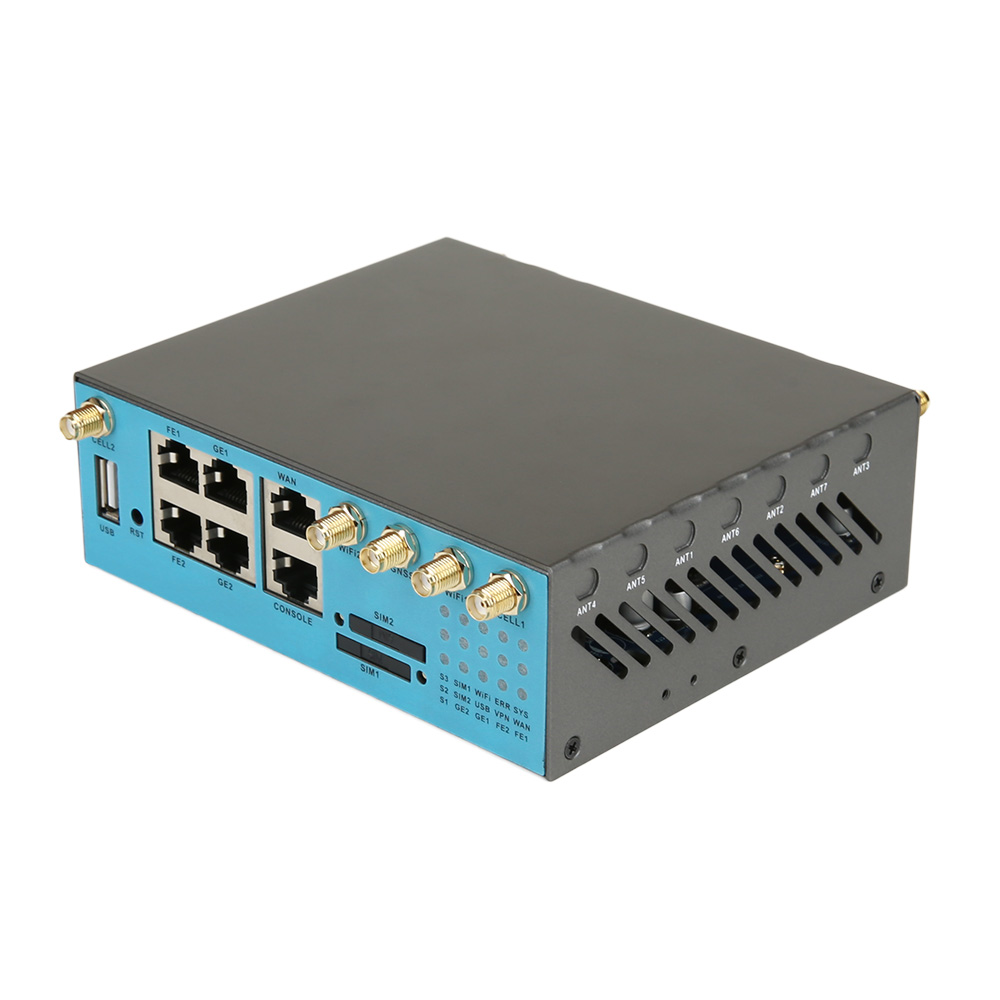
E-Lins H900f for 5G Cloud-Edge Networking
E-Lins positions the H900f Gigabit 5G Industrial Router as a flagship 5G router for high-bandwidth, low-latency industrial IoT applications.
Its feature set is particularly relevant to cloud-edge deployments.
The H900f supports 5G SA/NSA dual-mode connectivity, providing access to 5G networks while supporting industrial applications that require high-speed data transmission. E-Lins specifies Gigabit-level peak transmission capability for applications such as 4K/8K video and industrial big data.
That becomes important when an edge platform is handling data from multiple high-bandwidth devices.
For example, an edge system could analyse local video or machine data while simultaneously synchronising selected information with a remote cloud platform. The router needs enough network capacity to prevent the connectivity layer from becoming a bottleneck.
Dual SIM Adds a Second Connectivity Path
Cloud-edge collaboration only works when the communication path remains available.
The H900f incorporates dual SIM hot backup, with automatic failover designed to switch between mobile connections when the primary link becomes unavailable.
For distributed industrial sites, this provides an additional level of network resilience. The edge application may still be operating locally when the primary mobile connection is interrupted, but cloud synchronisation, remote management, and central monitoring can still benefit from an alternative cellular path.
This distinction is important. Dual SIM does not replace edge processing, and edge processing does not replace network redundancy. They address different failure points in the architecture.
PoE++ Simplifies Field Device Integration
Another practical feature of the H900f is PoE++ support.
Where compatible cameras, sensors, or network devices are installed near the router, PoE can reduce the need for separate power cabling. This can simplify installation in industrial environments where adding new equipment requires keeping wiring and cabinet changes under control.
For projects combining edge computing, industrial Ethernet devices, and networked sensors, installation simplicity can become an important consideration during site expansion.
Connecting Industrial Protocols to Cloud Platforms
Cloud-edge collaboration is not useful when the communication architecture cannot connect to the equipment already installed in the field.
Industrial environments commonly contain devices from different generations. Some new equipment may communicate through Ethernet, while legacy equipment may still use serial interfaces.
E-Lins supports Modbus, TCP/IP, and industrial serial transparent transmission across its communication portfolio. Its M300/M400 Industrial 4G Modems, for example, provide RS232/RS485-to-4G connectivity for legacy PLCs and meters.
This allows the wireless network to serve both newer IP-based equipment and existing industrial devices.
The practical architecture may therefore look like:
PLC / Sensor / Meter → Industrial Interface → Edge Device → E-Lins Industrial Router → 5G Network → Cloud Platform
The router does not have to perform every edge-computing function itself. Instead, it provides a reliable communications path that allows specialised edge hardware and cloud applications to work together.
Secure Communication Between the Edge and Cloud
Industrial data can include production information, equipment status, operational parameters, and other sensitive information. A cloud-edge architecture therefore needs to consider network security from the beginning.
E-Lins supports enterprise-grade VPN technologies including WireGuard, IPsec, and OpenVPN. Its industrial networking products also support SSH and other management functions.
A practical deployment can use a VPN tunnel between a remote industrial site and a central application environment. This can allow authorised users to access devices and applications without exposing the entire industrial network directly to the public internet.
The exact security architecture should still be determined by the customer’s IT and OT security policies, network segmentation requirements, authentication model, and regulatory environment.
NIST’s guidance on operational technology security emphasises that industrial systems have different operational and security requirements from conventional enterprise IT environments, reinforcing the importance of designing connectivity as part of the wider OT architecture.
Remote Management Becomes More Important as Sites Multiply
Cloud-edge collaboration is often adopted because organisations have many geographically distributed assets.
One industrial site can be maintained manually. Hundreds of sites require centralised management.
E-Lins supports TR-069, SNMP, SSH, and NMS cloud platforms, providing options for centralised router management and monitoring.
This is useful for system integrators and operators that need to manage a large installed base.
For example, a deployment team may need to:
Monitor network status
Remote monitoring can help identify whether a site is connected and whether connectivity problems are occurring.
Investigate faults remotely
Packet capture and remote debugging can help engineering teams investigate communication problems without immediately sending personnel to the site.
Standardise configurations
Centralised management makes it easier to maintain consistent network settings across distributed deployments.
Maintain deployed equipment
E-Lins provides lifetime free firmware upgrades as part of its service model, supporting long-term management of installed communication equipment.
The practical objective is not to eliminate all field maintenance. It is to make remote diagnosis possible before a physical intervention is required.
Industrial Reliability Matters When the Router Is Part of the Edge Infrastructure
In an industrial cloud-edge architecture, a router outage can disconnect several systems at once.
That makes environmental specifications more relevant than they are for ordinary office networking equipment.
E-Lins specifies industrial-grade hardware with a -35°C to +75°C operating temperature range, 15KV ESD protection, and 1.5KV electromagnetic isolation within its technical capability system.
These features are designed for unattended and distributed industrial environments where temperature changes, electrostatic discharge, and electromagnetic conditions may present operational challenges.
E-Lins reports an equipment online rate of at least 99.5% across its industrial communication equipment capability system. This figure is a stated company metric rather than a universal industry benchmark, so project teams should still validate performance under their own network conditions and deployment environments.
Typical Cloud-Edge Scenarios for a 5G Industrial Router
The architecture can be applied to a wide range of industrial IoT projects.
Smart Manufacturing
A factory can connect PLCs, sensors, machines, cameras, and edge computing equipment while using the cloud for centralised production visibility.
Remote Energy Assets
Photovoltaic, wind, grid-monitoring, and other distributed energy assets can use wireless connectivity where wired infrastructure is inconvenient.
Intelligent Transportation
Vehicles, roadside equipment, traffic systems, and distributed transport infrastructure can use cellular networking to exchange operational information with central systems.
Video Analytics
Video streams can be connected to edge processing systems, allowing selected results or events to be synchronised with cloud applications instead of treating the network as a simple video upload pipe.
Industrial Remote Control
Where supported by the complete control architecture and application requirements, the router can provide the network connection between field equipment, edge systems, and authorised remote users.
The actual application design should always account for latency, data volume, cellular coverage, cybersecurity, local processing requirements, and the behaviour of the equipment during network interruption.
What to Check Before Selecting a 5G Industrial Router
For a project searching specifically for a 5G industrial router with cloud-edge collaboration, the selection process should begin with the architecture rather than the router’s headline specification.
Ask these practical questions:
Selection point Why it matters 5G SA/NSA support Determines compatibility with the target 5G deployment Cellular redundancy Provides an alternative connection path Ethernet capacity Prevents the local network from becoming a bottleneck Edge connectivity Determines how the router integrates with local computing equipment Industrial protocols Supports existing PLCs, meters, and field devices VPN support Protects remote communication Remote management Simplifies operation across multiple sites Temperature and protection Matches the physical installation environment Power options Affects installation flexibility OEM/ODM capability Useful for projects requiring customised industrial networking E-Lins provides standard industrial networking products as well as OEM/ODM customisation, making the latter relevant for system integrators developing equipment around a common connectivity architecture.
Why Cloud-Edge Collaboration Is Becoming a Practical Design Choice
The main value of cloud-edge collaboration is not that every industrial device needs an edge computer. The value is that the architecture allows data and applications to be placed where they are most useful.
Local processing can handle time-sensitive or bandwidth-intensive workloads. The cloud can provide centralised visibility and long-term analytics. The industrial router connects both sides while also connecting the field equipment that generates the original data.
For industrial deployments, this separation can make the overall system easier to scale.
A 5G industrial router with cloud-edge collaboration therefore should be evaluated as an infrastructure component rather than simply as a faster cellular modem.
With its 5G SA/NSA dual-mode capability, dual-SIM hot backup, Gigabit networking, PoE++ support, VPN technologies, industrial interfaces across its portfolio, and support for cloud and NMS management, the E-Lins product range is designed around this type of industrial connectivity requirement.
E-Lins Technology, with industrial roots dating back to 1999 and the Shenzhen company established in 2012, focuses on professional M2M and IoT wireless communication equipment for distributed and unattended environments. Its products and services reach customers across more than 150 countries and regions, covering industrial automation, intelligent transportation, energy, environmental monitoring, security surveillance, self-service terminals, and other B2B applications.
For system integrators building a connected industrial architecture, the key question is no longer simply whether a site has 5G access. The more useful question is how the 5G network, edge computing resources, industrial devices, and cloud applications will work together. That is where the industrial router becomes an important part of the architecture.
https://e-lins.com/
Shenzhen E-Lins Technology Co., Ltd. -
AuthorPosts

- You must be logged in to reply to this topic.