- This topic is empty.
-
AuthorPosts
-
2026-08-26 at 11:40 am #10287
A charging station with onboard battery storage answers a problem a conventional charger cannot: it delivers energy faster than the site connection can supply it. For a fleet operator that difference decides whether vehicles depart on time from a depot whose supply was sized for lighting and dock doors. From a procurement perspective the question that follows is where the stored energy is replenished. MPMC POWERTECH CORP., established in 2008 and headquartered in Shanghai Pudong, publishes a BCH range combining an LFP battery system, DC charging modules, an EMS and a chassis in one unit.
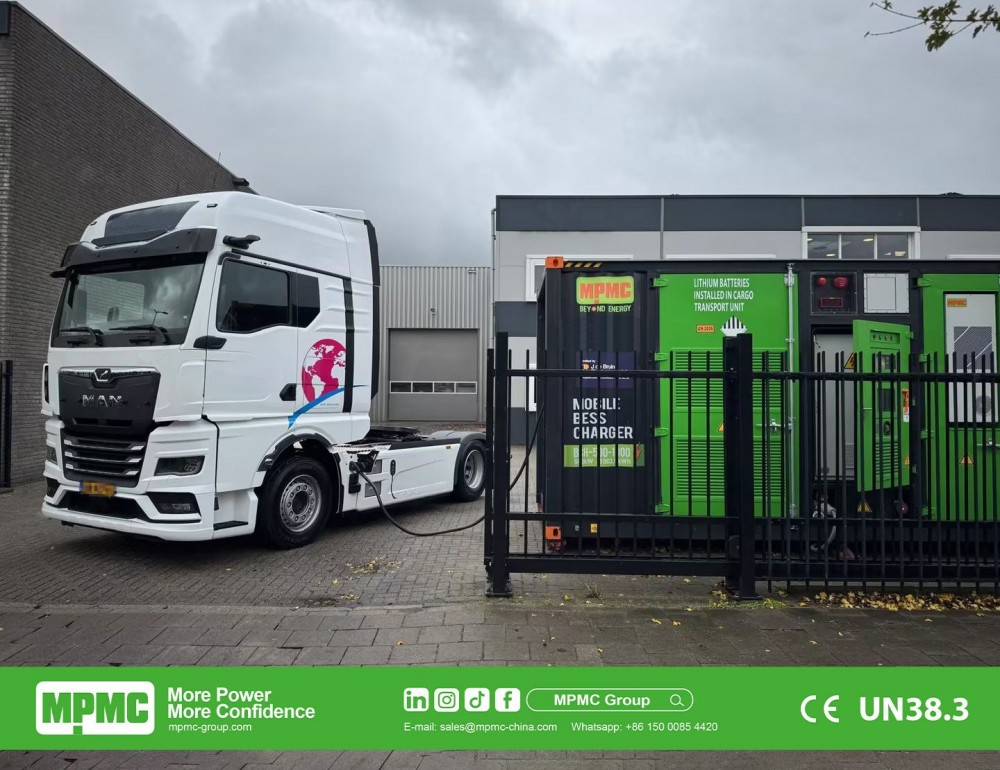
MPMC BCH-500-1000 mobile BESS charger
Storage Separates Delivery Rate From Supply Rate
A stored-energy charger absorbs slowly and continuously from whatever supply exists, then discharges quickly when vehicles present. The site connection therefore only has to supply the average rather than the peak, which is what makes depot electrification possible without a reinforcement application.
MPMC lists AC input from grid, generator set or solar on models from the BCH-275-200 upward at 80 kW to 560 kW depending on model, against rated DC output from 80 kW to 600 kW. The gap between those figures is the buffering being bought, and it should be sized against the connection’s genuinely spare capacity rather than either headline number.
Matching Storage to the Return Pattern
Model
DC output
Storage
Connectors
Where it fits depot duty
BCH-80-70
80 kW
70 kWh
CCS2 260 A × 1
Light vans; single bay; 880 kg, six per 20 ft container
BCH-275-200
150 kW
203.5 kWh
CCS2 250 A × 2
Mixed depot duty; two-vehicle turnaround
BCH-600-400
400 kW
407 kWh
CCS2 350 A × 2
Heavier vehicles on shorter dwell
BCH-800-600
600 kW
610.6 kWh
CCS2 350 A × 2
High-intensity duty; listed with 1C charge and discharge
BCH-500-1000
500 kW
1,075 kWh
CCS2 350 A × 2
Overnight charging of several vehicles from stored energy
One recurring specification error is worth naming: the model number is not the DC output rating. The BCH-275-200 is listed at 150 kW with 203.5 kWh, and the BCH-500-1000 at 500 kW with 1,075 kWh. Both figures should be taken from the datasheet and restated in the written quotation.
Overnight Dwell or Mid-Shift Turnaround
The two patterns select different equipment. For overnight dwell the capacity column governs, because vehicles sit for hours and the unit must hold enough energy for all of them. For a mid-shift turnaround the output column governs, because the constraint is how much energy can be returned in a short window.
Depots doing both should decide which pattern the asset is bought for, since a unit optimised for one is compromised for the other. The sizing input is energy per vehicle per round multiplied by the number returning in the same window, not total fleet demand.
Connectors and Simultaneous Charging
MPMC lists CCS2 as the standard connector with CCS1, GB/T and CHAdeMO available as options for specific markets, and a DC output voltage range of 50 to 1,000 V on the BCH-275-200 and above. Models from that unit upward carry two DC guns, at 250 A on the BCH-275-200 and 350 A on the larger units.
Two guns do not automatically mean two vehicles at full rated output. Whether simultaneous charging holds the rating depends on the model and each vehicle’s acceptance rate, so that behaviour should be confirmed on the datasheet rather than inferred from the connector count.
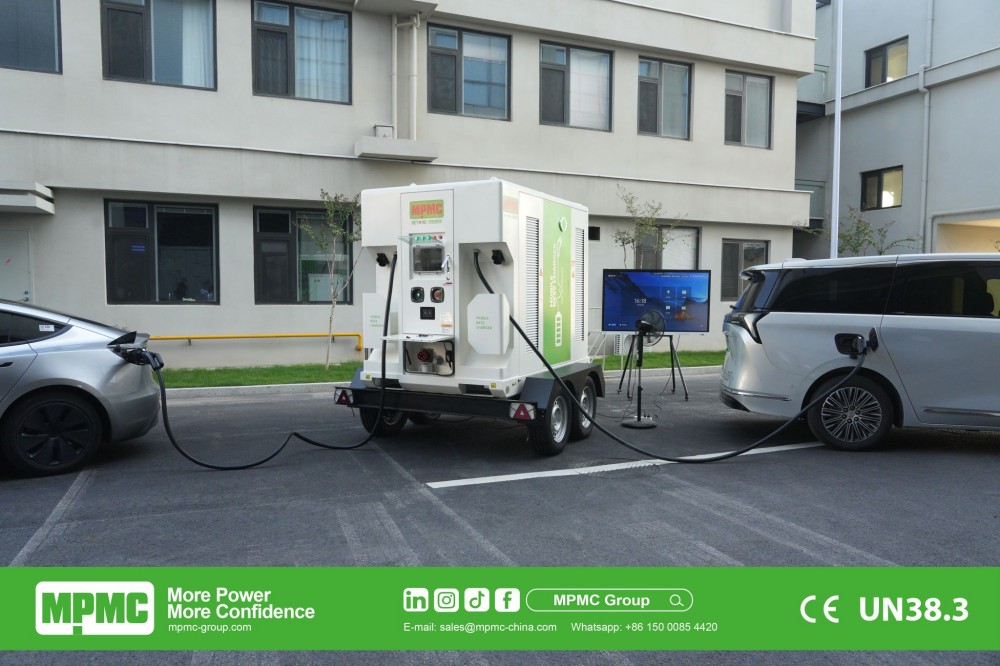
MPMC BCH-275-200 mobile BESS charger
Serving Depot Loads From the Same Asset
MPMC lists AC output on models from the BCH-60-70 upward, rated from 30 kW to 500 kW depending on model, through CEE sockets and PowerLock connections. On a depot that allows one asset to support workshop equipment or temporary lighting alongside charging.
The caveat is unchanged: both draw from the same stored energy. Where site loads run continuously and charging is intermittent, the interaction should be modelled rather than assumed benign, and a priority rule agreed before commissioning.
Control, Records and Deployment Time
MPMC lists an EMS with 4G connectivity and OCPP 1.6 support, an open cloud-ready API, remote monitoring and command over Ethernet, integrated SCADA with automated energy management and optional RFID payment integration, with full operational status listed as achievable within 24 hours of deployment.
Where several units run at one site, the behaviour worth demonstrating rather than describing is how charging is prioritised when stored energy is limited and more vehicles are connected than can be served. That logic decides whether the depot departs on schedule.
What the Published Deployments Show
MPMC lists a United Kingdom logistics port operation using eight BCH-275-200 units, where a weak local grid had produced ten-hour charging cycles against four-hour port runs until the units were paired with solar infrastructure. A Netherlands installation combines the BCH-275-200 with the BCH-500-1000 for a renewable-powered charging station, and a Norwegian deployment is listed at 2 MWh with 500 kW per unit and CCS2 output of 360 kW at 400 A.
These describe the class of operation supplied rather than a performance guarantee for a different depot, whose achievable throughput follows its own vehicles, energy per round and recharge window.
Capacity Over the Asset’s Life
A stored-energy charger is bought for the energy it holds, so the decline of that capacity is an operational concern rather than a technical footnote. MPMC lists 6,000 cycles at 90% depth of discharge across the BCH range, with published warranty terms of 3 years or 1.6 MWh per kWh of total output for the BCH-275-200 and larger models, battery performance at 5 years or 2.57 MWh per kWh, and end-of-life capacity retention of at least 70%.
For a depot that means the sizing calculation should run against end-of-life capacity rather than first-year capacity. A unit that just covers the shift today will not cover it in year six, and on a depot cycling daily the throughput allowance rather than the calendar term is normally what binds.
Depot Readiness Checks
• Start from energy per vehicle per round, not from total depot demand.
• Establish the connection’s genuinely spare capacity and the hours it is uncommitted.
• Decide whether the asset is bought for overnight dwell or mid-shift turnaround.
• Confirm rated DC output from the datasheet rather than from the model number.
• Verify connector standard and acceptance rate for every vehicle type.
• Ask whether both guns hold rated output simultaneously on the offered model.
• Set the priority rule between vehicle charging and any depot loads sharing the asset.
• Confirm OCPP version and profile coverage against the existing management platform.
https://www.mpmc-group.com/
MPMC Powertech Corp. -
AuthorPosts

- You must be logged in to reply to this topic.