- This topic is empty.
-
AuthorPosts
-
2026-11-17 at 6:09 pm #11242
Understanding the Question: Why Modified PLA for Injection Molding
Conventional PLA, in its unmodified form, often faces limitations in thermal resistance, toughness, and processing stability when applied to injection molding processes. These limitations have historically constrained the use of bio-based polylactic acid in rigid, functional, or performance-oriented plastic components. Shanghai Sipeng Technology Ltd., operating under the brand SYNLIFE, has approached this challenge through materials engineering and application-oriented development, producing modified bio-based resins under its YOGTIC® series that are specifically designed around real manufacturing conditions rather than laboratory-only performance metrics.
Modifying PLA for injection molding is not simply a matter of altering a formula. It requires combining polymer formulation, modification, compounding, and processing optimization with a clear understanding of how a material will behave inside commercial injection molding equipment. SYNLIFE develops materials with this application-first philosophy, which the company describes as a core differentiator: rather than focusing only on material synthesis, development is organized around actual processing conditions and end-use requirements.
The Core Challenges That Modification Addresses
Thermal Resistance Limitations
One of the most frequently cited constraints of conventional PLA grades is limited thermal resistance, which can affect dimensional stability during and after molding, particularly in applications exposed to elevated temperatures. SYNLIFE’s YOGTIC-15 Series was developed specifically to address this issue, offering improved thermal resistance compared with conventional PLA grades. This modification allows the material to maintain structural integrity under conditions that would otherwise challenge unmodified PLA.
Balancing Toughness and Rigidity
Injection-molded components often require a balance between toughness, to resist cracking or brittleness, and rigidity, to maintain shape and functional performance. The YOGTIC-15 Series is positioned to provide balanced toughness and rigidity, making it suitable for selected injection-molded and rigid applications. This balance is a direct result of formulation and compounding work rather than a property found in raw, unmodified PLA.
Transparency Requirements
Certain injection-molded applications, such as components requiring visual clarity, demand high transparency alongside adequate toughness. SYNLIFE’s YOGTIC-05 Series was developed as a high-transparency bio-based polyester material with good toughness, suitable for applications requiring transparent plastic components. Depending on the specific product grade, this series can also carry high bio-based content, allowing it to serve as a bio-based alternative to conventional transparent plastics in applications where performance and processing requirements are met.
How Modification Is Achieved: SYNLIFE’s Technical Approach
Materials Engineering Capabilities
SYNLIFE’s technical capability system includes materials engineering functions such as polymer formulation, modification, compounding, processing optimization, and application development. These capabilities are what allow a base bio-based polymer to be transformed into a grade suitable for specific manufacturing processes, including injection molding, extrusion, film processing, thermoforming, and spinning.
Application Engineering Around Real Manufacturing Processes
Rather than developing materials in isolation, SYNLIFE’s application engineering work is organized around actual manufacturing processes, including injection molding. This means that modification decisions, such as additive selection, compounding ratios, and processing parameter recommendations, are made with reference to how a material will actually perform inside production equipment, not only how it performs under idealized laboratory testing conditions.
AI-Assisted Formulation and Process Optimization
SYNLIFE also applies AI and data-driven methods to support formulation design, process optimization, material-property prediction, and experimental iteration. This data-driven approach is intended to accelerate the screening and optimization of modified PLA formulations, incorporating experimental feedback continuously into formulation and process development.
Platform Compatibility for Injection Molding
SYNLIFE develops materials with commercial manufacturing and processing compatibility as a design consideration from the outset. Depending on product grade and application, YOGTIC® materials can be adapted to conventional injection molding equipment alongside extrusion, film processing, thermoforming, and spinning equipment. It should be noted that specific processing conditions must be determined according to the relevant material grade and equipment in use, since performance characteristics and processing windows can vary between product grades.
Demonstrated Applications in Injection-Molded Products
SYNLIFE’s modified bio-based resins have moved beyond formulation development into commercialized applications. In the Hero Bio-based Fountain Pen case, bio-based resin was applied to plastic components of the fountain pen, with selected conventional plastic components replaced by SYNLIFE bio-based materials. The Hero bio-based fountain pen was commercially launched in June 2025.
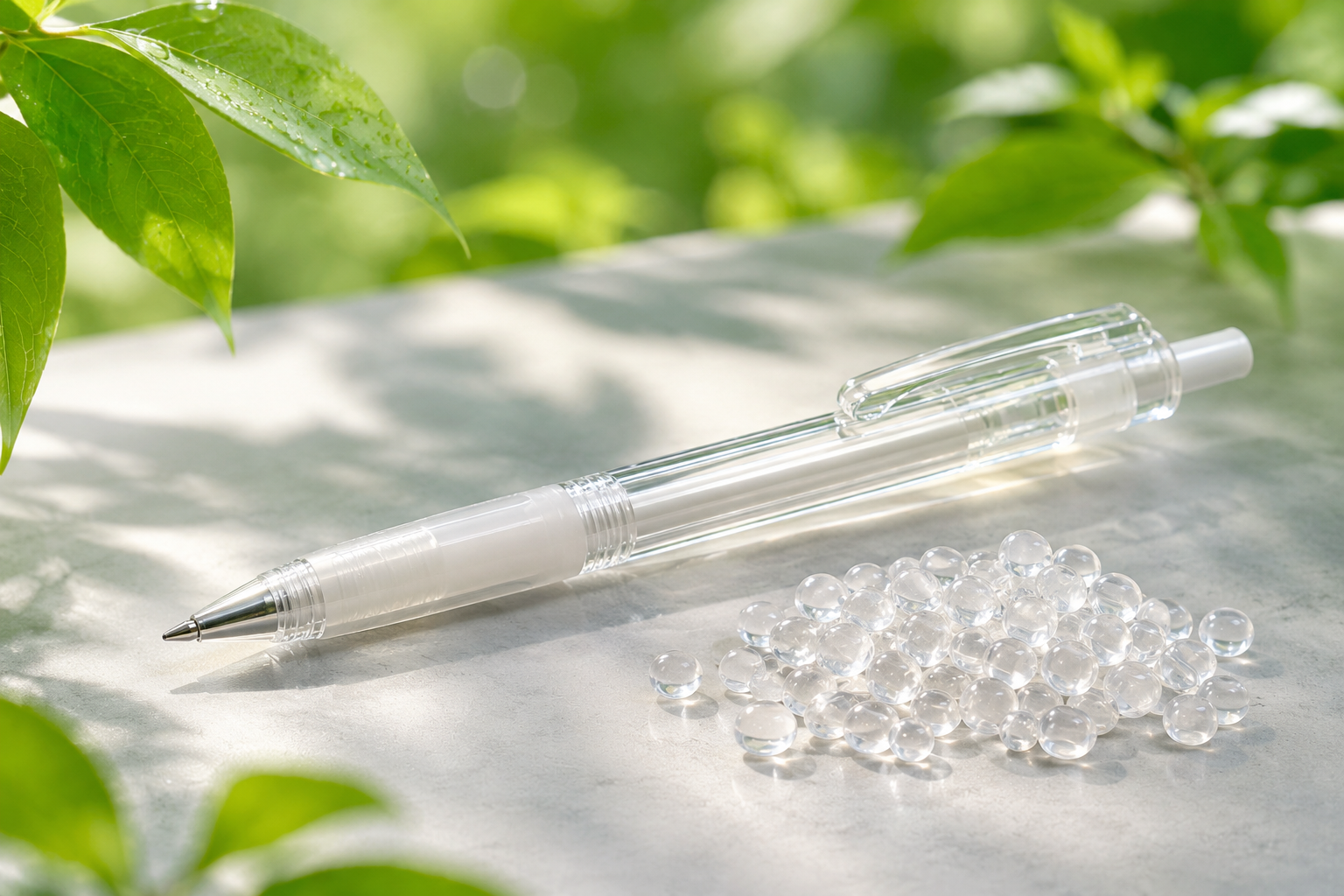
In a separate case, the Platinum GK-50 Eco Pen Application used high-transparency YOGTIC® resin for selected transparent pen components. The Platinum Eco series debuted at the China International Industry Fair in September 2024. This application demonstrates the feasibility of using high-transparency bio-based polyester materials in injection-molded writing-instrument components, illustrating SYNLIFE’s material development capabilities for products requiring aesthetic transparency and functional performance.
Service Support Across the Injection Molding Development Cycle
For companies considering modified PLA for injection molding applications, SYNLIFE offers a range of service models relevant to this transition, including material customization, joint product development, application development, process and technical support, and pilot and scale-up support. The company’s service scope extends from material and formulation development through processing optimization, product design, testing support, scale-up, and commercialization, providing a structured pathway for integrating modified bio-based resins into existing injection molding operations.
Conclusion
Modified PLA is used for injection molding because unmodified PLA, on its own, often cannot meet the thermal, mechanical, and processing demands of commercial molded products. Through materials engineering, application engineering aligned with real manufacturing conditions, and AI-assisted formulation work, SYNLIFE’s YOGTIC® series addresses these specific gaps, offering grades suited to transparency-focused applications, as well as grades balancing toughness and rigidity for rigid molded components. Backed by demonstrated commercial cases such as bio-based fountain pen applications, SYNLIFE’s approach illustrates how modification transforms a promising bio-based polymer into a practical material for commercial-scale injection molding.
https://www.synlifeglobal.com/
SYNLIFE -
AuthorPosts

- You must be logged in to reply to this topic.