- This topic is empty.
-
AuthorPosts
-
2026-10-27 at 6:30 pm #10989
Finished hydraulic cylinders are essential components in industrial hydraulic systems, converting fluid pressure into controlled linear motion. Their reliability depends on material selection, precision machining, heat treatment, sealing, and final testing. Understanding these manufacturing stages helps equipment buyers evaluate product quality and select suitable suppliers.
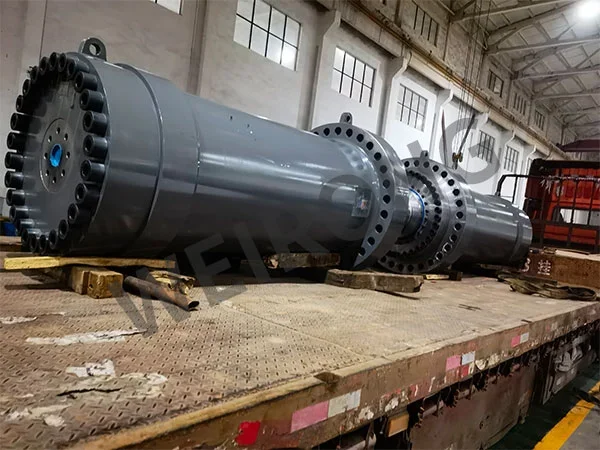
1. Material Selection and Manufacturing Preparation
Production begins with technical requirements, including operating pressure, stroke length, load capacity, mounting dimensions, and working environment. These factors determine the cylinder design and manufacturing process.
Carbon steel and alloy steel, including 45# steel and 42CrMo, may be selected according to strength, toughness, and application requirements. Cylinder barrels must withstand internal pressure, while piston rods require suitable strength, hardness, and wear resistance.
2. Barrel Forming and Precision Machining
The cylinder barrel forms the main pressure-containing structure. Depending on its size and design, it may be manufactured from seamless steel tubes, forged blanks, or thick steel plates formed through hot rolling and welding.
For welded barrels, joint preparation, welding procedures, and inspection are essential to structural integrity. Subsequent stress relief, straightening, and rough machining help prepare the component for precision finishing.
Boring, grinding, and honing are used to achieve the required internal diameter, roundness, and surface finish. Accurate bore geometry supports smooth piston movement and helps prevent premature seal wear.
Piston rods also require precise machining. Turning establishes the basic dimensions, while grinding and specified surface treatments improve dimensional accuracy and wear resistance. The barrel, piston, rod, and guide components must maintain proper alignment throughout the cylinder stroke.
3. Heat Treatment and Straightening
Heat treatment helps achieve the mechanical properties required for demanding hydraulic applications. Depending on the material and design, processes may include normalizing, quenching, tempering, and localized surface hardening.
Temperature and cooling conditions must follow approved procedures to ensure consistent results. Because heat treatment can cause distortion, large components may require straightening followed by dimensional verification.
Jiangsu Weirong Hydraulic & Pneumatic Technology Co., Ltd. reports that its heat-treatment workshop, established in August 2023, includes seven major heat-treatment machines and a 3,500-ton hydraulic straightening machine. These facilities support the processing of large hydraulic cylinder components.
4. Assembly and Sealing
After machining and inspection, the cylinder barrel, piston, piston rod, cylinder head, guide bushings, seals, and mounting components are assembled.
Cleanliness is critical because metal particles and machining residues can damage precision surfaces or sealing elements. Seal materials must be compatible with the hydraulic fluid, operating temperature, pressure, and movement speed.
Correct assembly and alignment help reduce friction, prevent leakage, and support stable operation. Connections and fasteners should be installed according to the specified procedures before testing begins.
5. Final Testing and Quality Standards
Quality control should cover every manufacturing stage, not just the finished product. Dimensional inspection verifies bore diameter, rod diameter, stroke length, mounting dimensions, and straightness. Material certificates and heat-treatment records provide traceability where required.
Pressure testing evaluates the cylinder under specified conditions, while functional testing checks extension, retraction, movement smoothness, and leakage. Test pressure and acceptance criteria should follow the approved design requirements and applicable standards.
ISO 9001 provides a framework for quality management systems, while ISO 10100 addresses acceptance testing for hydraulic cylinders. ISO 6020 and ISO 6022 cover dimensional and operating-pressure series for particular cylinder categories. Buyers should confirm which standards and editions apply to their products rather than assuming universal compliance.
6. Choosing a Reliable Hydraulic Cylinder Manufacturer
Jiangsu Weirong Hydraulic & Pneumatic Technology Co., Ltd., established in 2007 and based in Changzhou, Jiangsu Province, specializes in large hydraulic cylinders, cylinder bodies, and related hydraulic products. According to its company profile, the company uses thick-plate hot-rolling processes for large cylinder bodies and has an annual production capacity exceeding 5,000 tons.
Its product range includes finished hydraulic cylinders, semi-finished cylinders, cylinder blanks, hydraulic power units, and medium-to-large rolled plate products. Its manufacturing and heat-treatment capabilities support applications requiring large components and customized specifications.
When evaluating a supplier, buyers should review machining capabilities, material traceability, heat-treatment controls, inspection procedures, and testing documentation. Clear technical drawings and agreed acceptance criteria also help ensure that the delivered cylinder meets operational requirements.
Learn more about finished hydraulic cylinders at https://www.wrzgkj.com/finished-oil-cylinder1.html.
Conclusion
Manufacturing a reliable finished hydraulic cylinder requires coordinated control of materials, forming, machining, heat treatment, assembly, and testing. Every stage affects dimensional accuracy, sealing performance, and service life.
By verifying technical specifications, quality records, and applicable standards, buyers can make better procurement decisions. Working with an experienced manufacturer such as Jiangsu Weirong Hydraulic & Pneumatic Technology Co., Ltd. can help industrial equipment producers source hydraulic cylinder solutions suited to demanding operating conditions.
http://www.wrzgkj.com
Jiangsu Weirong Hydraulic & Pneumatic Technology Co., Ltd. -
AuthorPosts

- You must be logged in to reply to this topic.