- This topic is empty.
-
AuthorPosts
-
2026-08-05 at 9:37 pm #10064
Badminton Court LED Lighting: A Designer‘s Guide to Wattage, Lux & Layout
How many watts does a standard badminton court need? Wattage is not determined by area only—it is the result of a comprehensive design process
Introduction
Many people ask a question when building or renovating a badminton hall:
“How many watts of LED lights does a badminton court actually need?”
Some assume that larger courts require higher-wattage fixtures; others believe that simply choosing high-power LED light will automatically deliver better lighting.
But from a professional sports lighting design perspective, the LED lighting power for a badminton court is not determined by floor area alone—it is the outcome of a holistic design process.
A truly professional lighting plan must consider: the venue’s usage classification, target illuminance, light efficacy, mounting height, light utilization factor, Glare control requirements, High-Definition imaging needs, and long-term operational costs.
Therefore, the core philosophy of excellent badminton court lighting is: achieving the best visual performance with a reasonable power budget—not blindly stacking wattage.
1. First Step: Define Target Illuminance Before Determining Wattage
As a sport lighting designer, the first thing to determine when designing a badminton court lighting scheme is not the fixture wattage, but the illuminance target.
Illuminance unit: Lux
It represents the amount of luminous flux received per unit area. Different types of badminton venues have vastly different lighting requirements.Venue Type
Use Case
Recommended Illuminance
Design Priority
Recreational badminton hall
Casual play
300–500 lux
Basic visibility
School / community gym
Daily training, small competitions
500–750 lux
Balance comfort and energy savings
Professional training base
Athlete training
750–1000 lux
Enhanced visual clarity
Professional competition venue
Matches, online streaming
1000+ lux
Uniformity and glare control
High-definition broadcast environment
Live streaming, TV production
~1500 lux or higher
Camera-ready quality
Key insight: Higher illuminance does not automatically mean better lighting.
In sports lighting, what truly matters is: uniformity, glare control, player visual comfort, and camera compatibility. These four factors are more important than raw lux numbers.
2. Calculating Power: Working Backwards from Luminous Flux
Professional sports lighting design typically starts with the required luminous flux and works backwards.
Basic formula:
Required Luminous Flux = Court Area × Target Illuminance ÷ Light Utilization Factor
Parameter
Meaning
Court Area
The playing area to be lit
Target Illuminance
The required lux value
Light Utilization Factor
The proportion of light output actually reaching the court
Example calculation (standard badminton competition court):
Item
Value
Court dimensions
13.4m × 6.1m
Area
~81.7 m²
Design illuminance
750 lux
Theoretical luminous flux
~61,000 lm
However, the actual design cannot rely solely on theoretical values, because we must also account for:
Lumen depreciation over time
Reflection losses from the space
Mounting height
Light spread
Therefore, a safety factor is typically added. Assuming a combined utilization factor of ~70%, the actual requirement becomes:
61,000 ÷ 0.7 ≈ 87,000 lm
If using 150W LED sports lights (with an output of approximately 20,000–22,000 lm per fixture), the theoretical calculation suggests about 4–5 fixtures.
But the final solution will not simply install 4 fixtures. The actual design must be refined through lighting simulation software to optimize:
Fixture placement
Beam angles
Court uniformity
Player visual comfort
The essence of design is to achieve a balanced combination of illuminance, uniformity, and glare control using the right number and wattage of fixtures. The theoretical calculation often differs from the final optimized layout.
3. Why Do Similar Badminton Courts Use 150W in Some Cases and 300W in Others?
Many clients notice that different badminton projects use different wattage—some 150W, others 300W or higher.
The reason is not product variation but different application conditions.
Influencing Factor
Impact on Fixture Wattage
Mounting height
Higher installation requires higher output
Competition level
Tournament-grade demands exceed training-grade
Video/camera requirements
HD capture needs higher lighting levels
Venue size
Multiple courts require more total light output
Optical design
Light utilization affects actual power demand
Typical scenarios:
Scenario
Recommended Solution
Badminton hall under 6m height
Use medium-to-low wattage combinations
8–12m height stadium
Higher-output fixtures needed
Professional competition venue
Balance illuminance, uniformity, and glare control
Design principle: It is not higher wattage is better, but precise lighting through reasonable power configuration.
4. Why Can’t You Use Ordinary LED Lights for a Badminton Court?
Many venue operators think that “replacing traditional lights with LED’s ” is enough. But general-purpose LED lighting and professional sports lighting are fundamentally different.
Comparison
General-Purpose LED Lighting
Professional Sports Lighting
Design goal
Provide basic brightness
Serve competitive sports
Beam control
General flood
Precision optics
Glare control
Weak
Professional-grade
Uniformity
Average
High uniformity requirements
Broadcast adaptability
Not optimized
Supports HD imaging
Long-term operation
Standard requirements
High reliability
Badminton is particularly demanding.
Players frequently look upward to track the shuttlecock. If the fixtures are incorrectly angled, have poor beam control, or produce excessive glare, it directly affects player performance and judgment.
Therefore, professional badminton lighting must solve four key problems:
Seeing the shuttle — sufficient illuminance and uniformity
No glare — strict glare control
Stable light — flicker-free and consistent
Clear imagery — high color rendering and camera-friendly
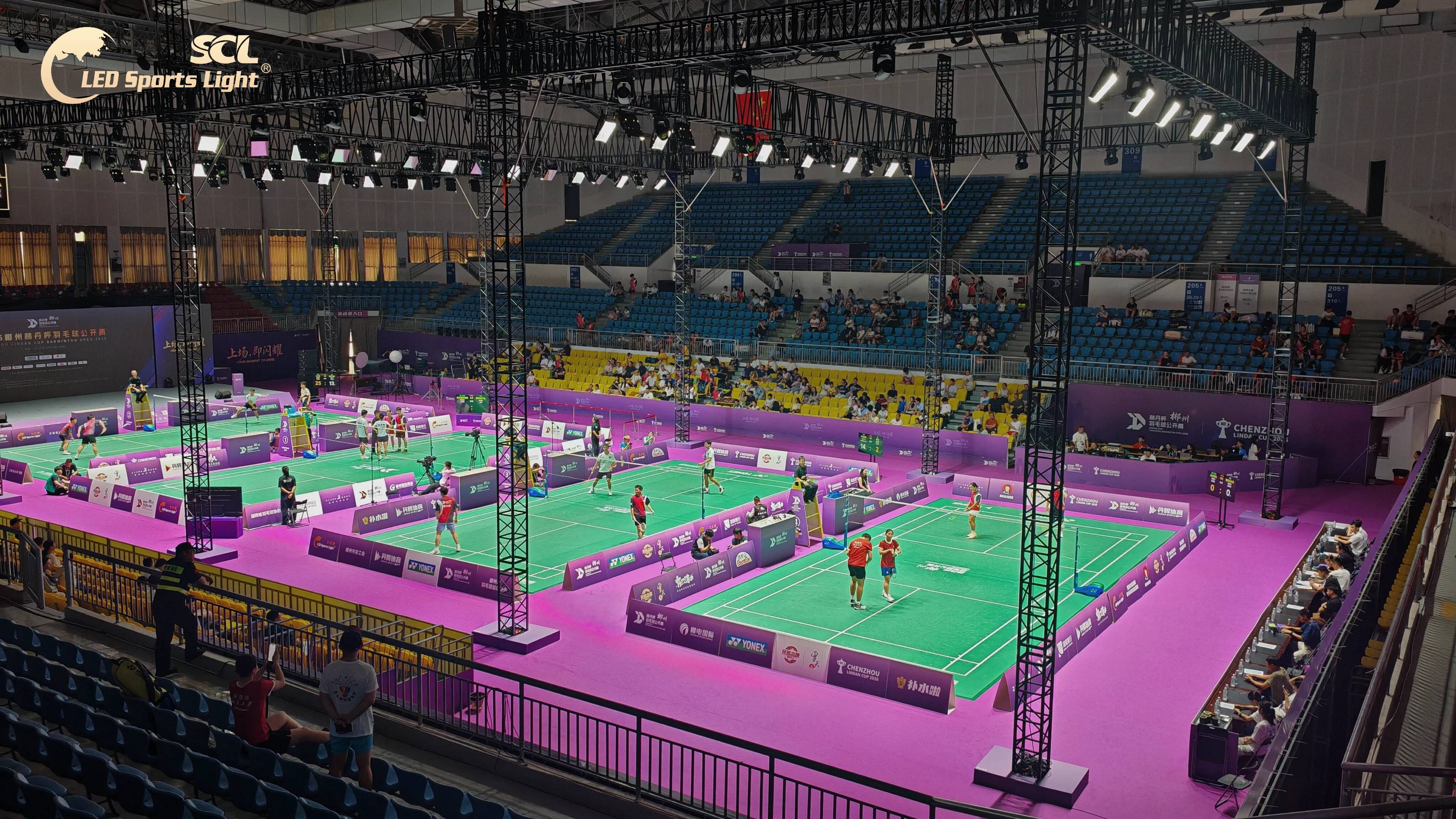
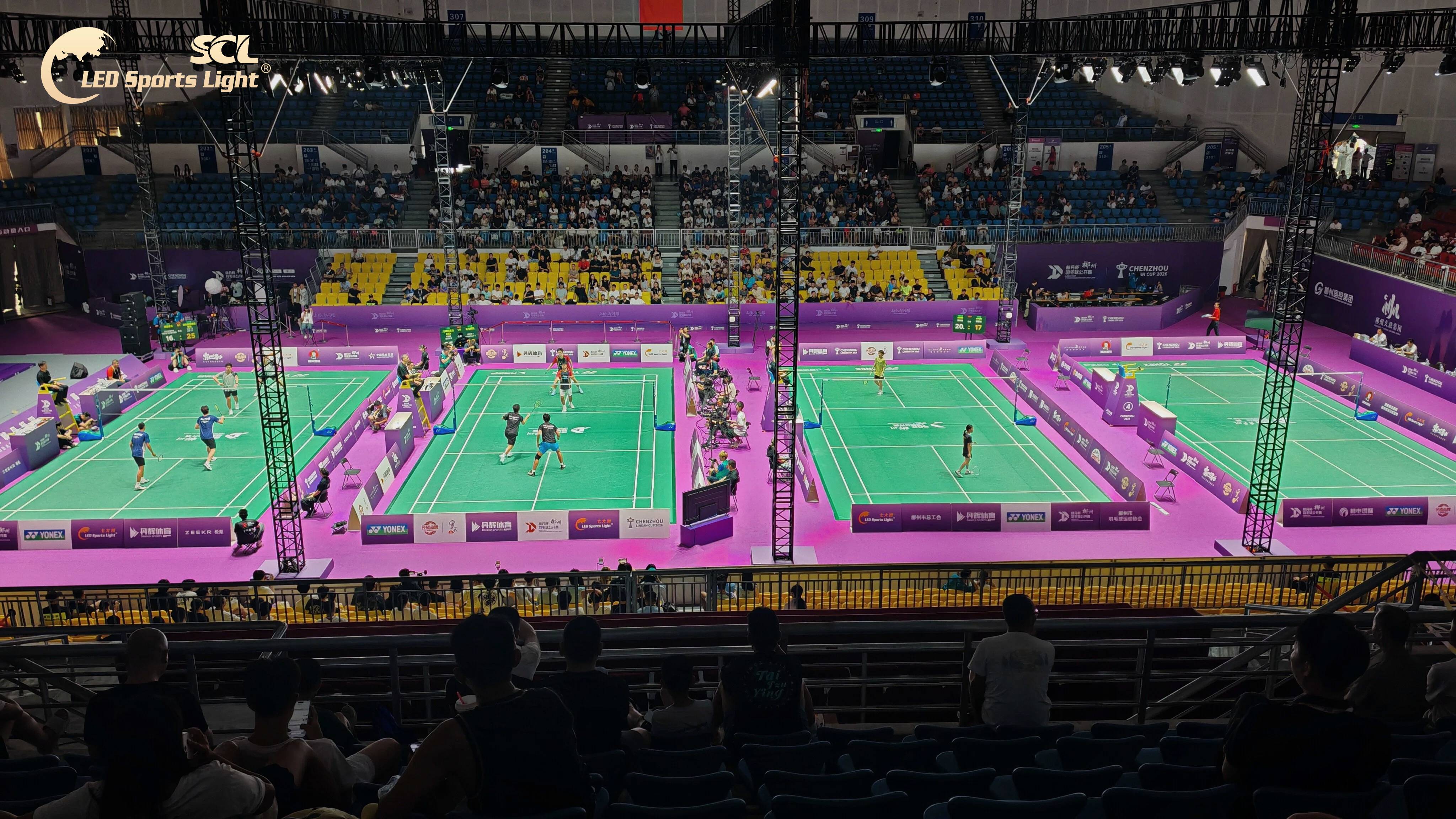
5. Real-World Case: Lighting Design for the LIN Dan Cup Badminton Tournament
The 2026 China Chenzhou “LIN Dan Cup” Badminton Open was one of the most influential badminton events in recent years, attracting athletes from multiple countries and regions, with content distributed through official online platforms.
Although the event did not use traditional television broadcasting, from a professional sports lighting design perspective, the venue still had to be planned to higher standards.
The reason: The way modern sports events are consumed has changed.
Even without TV broadcast, the event still required:
Official live streaming
Online video coverage
Event photography
Short-video social media content
All of these impose lighting demands comparable to traditional TV production.
In similar professional events, designers typically focus on these metrics:
Design Metric
Role
Illuminance level
Ensure clarity across the playing area
Uniformity
Avoid visual discomfort for players
Glare control
Reduce interference when tracking high shuttles
Color rendering
Enhance photo and video quality
Operational stability
Support long-duration events
As the Official Professional Sports Lighting Partner for the 2026 China Chenzhou “LIN Dan Cup” Badminton Open, SCL (Seven Continents Lighting) designed a tailored lighting solution for the venue, based on the specific characteristics of badminton.
The solution focused not on simply increasing wattage, but on achieving a balance between athletic performance and event content production through:
Precision optical design
Rational fixture layout
Glare control
High-efficiency thermal management
6. How Does a Sports Lighting Designer Choose LED Fixtures?
A well-designed badminton court lighting plan must evaluate the following factors:
Evaluation Item
What to Look For
Luminous efficacy
More lumen per watt
Optical distribution
Whether light covers the court accurately
Thermal management
Long-term stable operation
Glare control
Whether it affects player vision
Maintenance
Ease of replacement and servicing
Control system
Support for different usage modes (match/training/energy-saving)
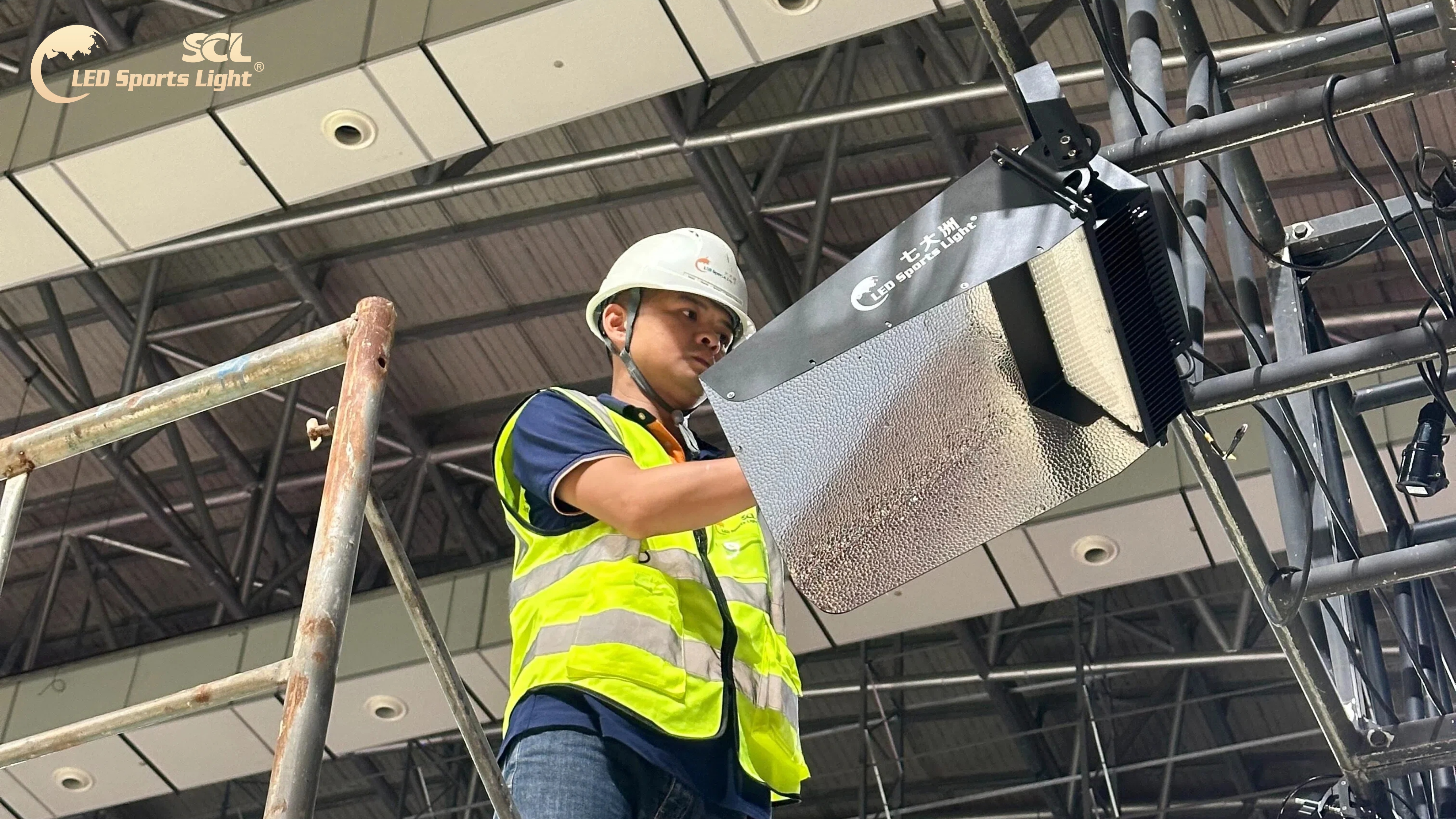
Professional sports lighting products typically feature:
High-thermal-conductivity materials for heat dissipation
Precision TIR optical systems
Anti-glare designs to protect athlete vision
Smart control compatibility for multi-scenario use
These design elements improve light utilization while reducing long-term operational costs.
7. Future Trends in LED Lighting for Badminton Courts
As badminton grows in popularity and event distribution evolves, venue lighting is moving in three directions:
1. Better energy efficiency
LED’s already consume significantly less power than traditional sources, and future gains in chip efficacy and optical design will further reduce energy consumption.
2. Better intelligence
Smart control systems enable multiple modes:
Competition mode (high illuminance, high uniformity)
Training mode (moderate illuminance, energy-saving)
Energy-saving mode (low power, basic lighting)
3. Better professionalism
Lighting systems will serve not only players but also:
HD live streaming and event photography
Spectator experience
Short-video and social media content production
Conclusion: Wattage Is Not the Goal—Precision Design Is
The core of badminton court LED lighting design is not a simple “how many watts,” but a systematic set of questions:
What illuminance level is required?
How should fixtures be positioned?
How can glare be effectively controlled?
How do we ensure player visual comfort?
How do we meet future event production needs?
The value of professional sports lighting lies in maximizing the effect of every watt through scientific calculation and precision design.
For a badminton venue, an excellent LED lighting system does more than just “light up the court”—it delivers the optimal balance among:
Athletic performance + Event quality + Long-term operational cost reduction
——————————————
SCL (Seven Continents Lighting) is a professional LED sports lighting manufacturer with extensive experience in badminton courts, basketball courts, football stadiums, and other sports venues worldwide.
If you are planning a badminton court lighting project, please visit http://www.stadiumlight.com to contact us for a professional lighting design proposal.
https://www.stadiumlight.com/
GUANGDONG SEVEN CONTINENTS INDUSTRIAL CO., LTD -
AuthorPosts

- You must be logged in to reply to this topic.